
 PMD in the News
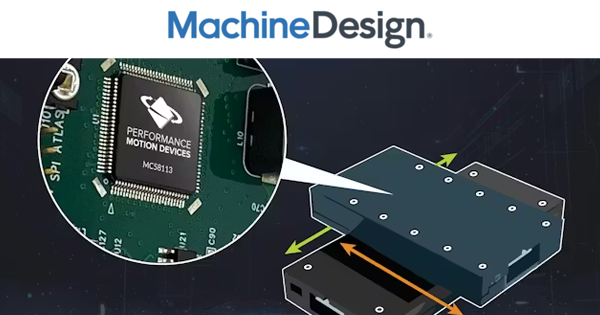
The article “Actuators and Drives: Foundations of High-Performance Motion Systems” explains how actuators and drives serve as the core building blocks of modern motion control systems. It emphasizes that achieving high performance in any automated machine depends not just on control algorithms, but on how effectively energy is converted into motion and precisely regulated. Actuators function as the physical mechanism that produces movement, while drives act as the intermediary that translates control signals into usable power for those actuators. Together, they form the essential link between digital control systems and real-world mechanical motion.
A central theme of the article is that actuator selection plays a critical role in determining system performance. Different actuator types—such as electric, pneumatic, and hydraulic—offer tradeoffs in power density, speed, precision, and efficiency. Electric actuators, particularly those based on servo motors, are commonly used in high-precision applications due to their controllability and responsiveness, while other technologies may be better suited for high-force or rugged environments. Choosing the right actuator requires careful consideration of application requirements such as load, duty cycle, environmental conditions, and desired motion characteristics.
The article also highlights the importance of drives in enabling precise and dynamic control of motion. Drives regulate voltage and current delivered to the actuator, allowing fine control over torque, speed, and position. Modern drives often incorporate advanced features such as closed-loop feedback, real-time diagnostics, and embedded intelligence, which improve system responsiveness and stability. By tightly integrating with controllers and feedback devices, drives help ensure that commanded motion profiles are executed accurately, even in the presence of disturbances or changing loads.
Another key takeaway is that high-performance motion systems depend on the seamless integration of actuators, drives, sensors, and mechanical components. Feedback devices such as encoders and resolvers continuously provide position and velocity data, enabling closed-loop control systems to correct errors and maintain precision. Mechanical elements like gears, belts, and linear guides further shape how motion is transmitted and applied. When these components are properly matched and tuned, the result is a system capable of high speed, accuracy, and repeatability.
Overall, the article frames actuators and drives not as isolated components, but as foundational elements of a larger motion control architecture. Their proper selection and integration are essential to achieving the performance, efficiency, and reliability required in advanced applications ranging from robotics and automation to precision manufacturing systems.
Click here to read the full article on Machine Design.