
 Case Studies

From Cirque du Soleil to local theater productions, moving sets, props, and people around a stage requires precise, reliable control that doesn’t leave anything — or anyone — hanging.
In modern theater, concerts, and live entertainment, motion is not just mechanical; it is expressive. Scenery glides into place, performers fly above the stage, massive LED walls ripple and transform, and lighting trusses move in precise choreography. Behind those moments is Creative Conners, a Rhode Island–based company that designs and manufactures the machines, controls, and software that make complex stage motion safe, repeatable, and visually compelling.
Creative Conners specializes in what it calls the building blocks of stage automation. Rather than delivering monolithic, one-off systems, the company provides modular machinery, standardized control hardware, and intuitive software that can be combined and configured by integrators, designers, and production teams across a wide range of venues — from high schools and regional theaters to world-class touring shows and permanent installations.
“We design and manufacture the machines, we design and manufacture the controls, and then we write the software,” explains Christian Basse, senior controls engineer at Creative Conners.
This vertically integrated approach allows Creative Conners to serve an unusually broad customer base. The same underlying technology used in demanding productions like Cirque du Soleil and Dave Matthews Band is also rented to schools staging productions of Les Misérables.
Regional theaters represent the company’s largest market, a segment that historically lacked access to sophisticated automation tools. A philosophy based on making stage automation more approachable has heavily influenced Creative Conners’ decision to rethink its motion control platform and turn to Performance Motion Devices (PMD) for help.

A Standard Controller at the Center of Everything
At the heart of most Creative Conners systems is a standardized control box known as the Stagehand. While the machinery might be custom, the Stagehand controller remains largely the same across applications.
“We’ve really spent a lot of time and effort into refining that piece of the equation, that controller, and made it pretty universal for our use case,” Basse says.
The Stagehand interfaces with variable-frequency drives (VFDs), encoders, and safety systems, while also serving as the execution layer for cues created in Creative Conners’ Spike Mark software. Those cues define where elements move, how fast they travel, how long they wait, and how they coordinate with other stage actions. Once triggered, those commands are executed locally by the controller.
Because the Stagehand sits at the intersection of hardware, software, and user interaction, the choice of motion controller IC is critical. For years, Creative Conners relied on legacy motion control chips from Texas Instruments. Over time, however, those devices began to limit what the company could deliver.
Overcoming Control Limitations
Creative Conners’ earlier motion control ICs imposed several constraints that became increasingly problematic as productions grew more ambitious. The most significant limitation was the inability to independently control acceleration and deceleration profiles.
“On the old IC, we were locked to symmetric accel/decel,” Basse explains. “Whatever you loaded for the acceleration, you had to use that for the decelerate.”
That constraint clashed directly with the visual and safety requirements of stage motion. In many scenarios, Creative Conners wants scenery or performers to enter the stage quickly but stop slowly and deliberately. “We want to hurry up, get it onto stage, get it moving,” Basse says, “but then we want a nice, smooth, deliberate-looking stop.”
With symmetric profiles, that level of nuance was impossible. Even more limiting, acceleration parameters could not be changed on the fly, which was especially problematic for performer flying effects where motion characteristics change dynamically throughout a cue.
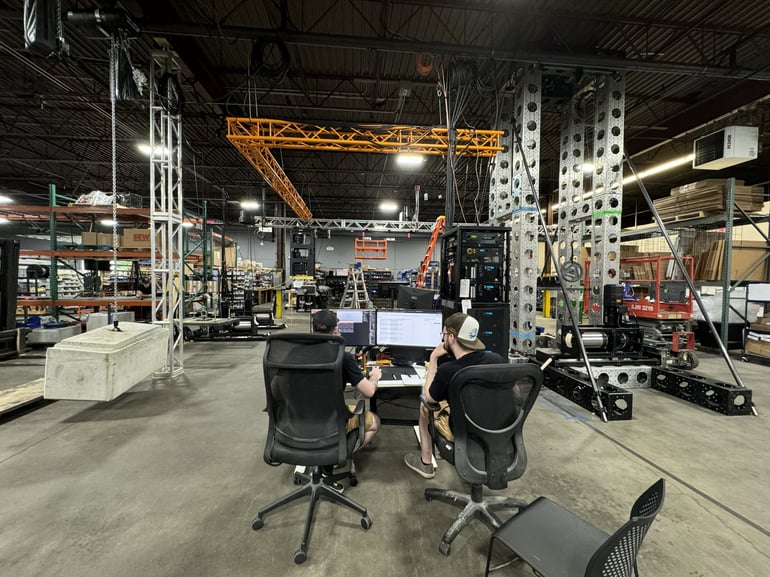
CDS shop testing for safety and motion functionality.
Availability also became an issue. The older motion controller was both aging and increasingly difficult to source — a challenge exacerbated by pandemic-era supply chain disruptions. Creative Conners needed a solution that fit its modular design ethos, offered a richer feature set, and could be reliably procured.
After evaluating several options, the team selected PMD’s Magellan MC58113 motion control IC.
PMD’s MC58113: Stagehand’s Heart and Soul
Creative Conners built a new Stagehand control PCB around the MC58113, pairing it with a microprocessor and a local HMI display. This board now serves as the “heart and soul” of the Stagehand controller.
“It’s what interfaces with our software,” Basse says. “It interfaces with the variable-frequency drives, and it’s what the end user interacts with when they’re standing next to it, just trying to jog the thing around.”
The MC58113 immediately unlocked capabilities that had been out of reach with the previous controller.
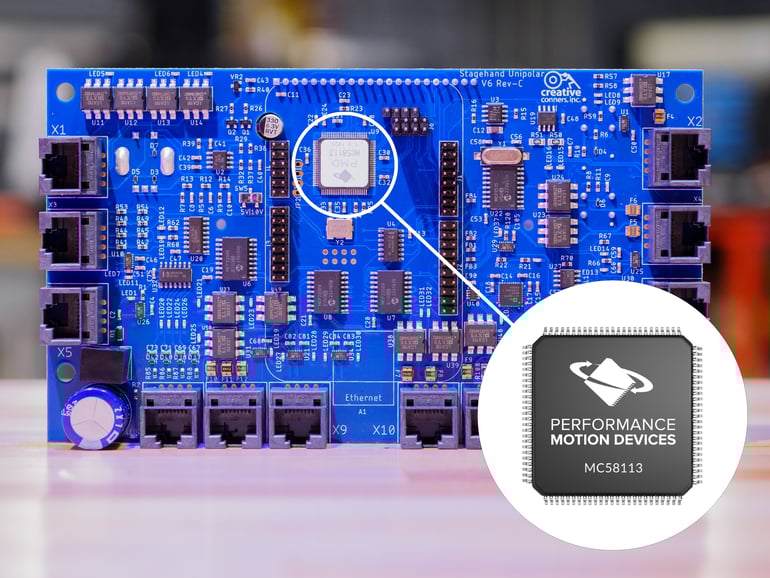
PMD’s MC58113 IC on the Stagehand PCB.
Asymmetric Accel/Decel Profiles
The single biggest improvement was support for asymmetric acceleration and deceleration, with the ability to change those parameters dynamically during a motion sequence.
“For us, that was the absolute biggest reason,” Basse notes. “Not being able to change the accel on the fly was a huge limitation before.”
Absolute Encoder Support
The MC58113 also enabled Creative Conners to support absolute encoders, a feature that had previously been off the table.
“If it’s going to move without the machine and the controls being powered, you’re not going to lose the position,” Basse explains. This is critical in rescue scenarios, where a performer may need to be manually lowered using mechanical brakes while the controller is powered off. When power is restored, the system still knows exactly where it is.
While not required in every application, absolute encoders are essential for permanently installed infrastructure hoists and for the most demanding, high-end customers pushing the limits of stage automation.
Bidirectional ±10 V Control for Hydraulics
Another regained capability was the ability to generate a ±10 V speed signal using an external DAC. This is necessary for hydraulic valves that interpret negative voltage as reverse motion and positive voltage as forward motion.
“When we moved to a newer TI controller, we lost the ability for that bidirectional signal,” Basse says. “Moving to the PMD controller gave us the ability to throw in an external DAC and do a bidirectional signal again.”
Restoring this capability ensured that the company would not have to turn away certain specialized applications.
Improved Diagnostics and Tuning
Beyond headline features, the MC58113 delivered unexpected benefits. Built-in tracing and monitoring tools allow Creative Conners’ engineers to visualize motion behavior over time, making it easier to diagnose issues and fine-tune performance.
The controller’s highly tunable position filters also help the system stay precisely on target. “We really care about the quality of motion. Not just that it looks nice but that it is where it’s supposed to be when it’s supposed to be,” Basse says. In tightly choreographed productions, positional accuracy is just as important as smoothness.
Faster Development With PMD Software Libraries
One benefit Creative Conners did not anticipate (but quickly came to appreciate) was PMD’s C-Motion® C/C++ software library. Instead of writing low-level serial communication code and message-packing routines from scratch, the team could rely on PMD’s command-driven API.
Sending a command is just a call to a C-Motion function. “That saved so much time and has been invaluable to us,” Basse says.
This accelerated firmware development and allowed Creative Conners’ small engineering team to focus on higher-level functionality and user experience rather than reinventing motion control plumbing.
Collaboration and Support That Made a Difference
Technical capability alone was not the only factor in Creative Conners’ success with PMD. The level of support and responsiveness proved equally important.
“I can just email a question and get a response very quickly,” Basse says. That accessibility was especially valuable during initial development, but it became critical when Creative Conners needed capabilities beyond the standard feature set.
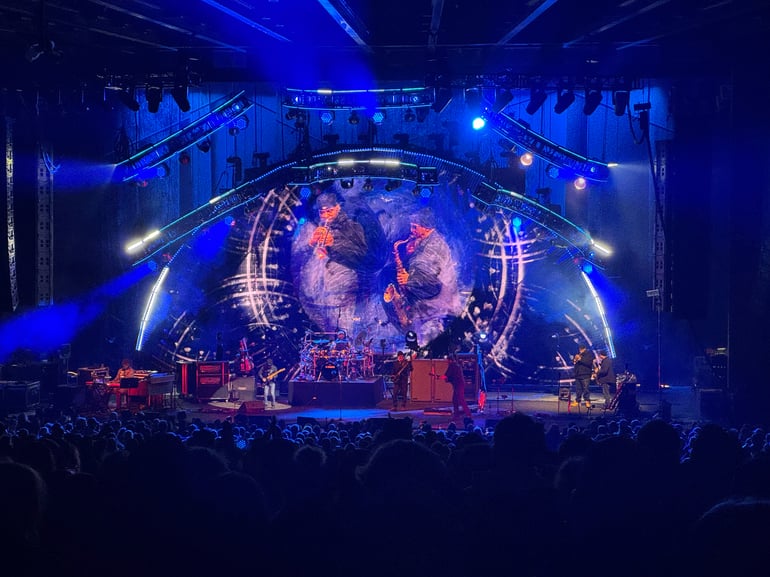
A Dave Matthews Band performance brought to life through Creative Conners' stage automation and the motion control capabilities of PMD.
In one case, Creative Conners required greater encoder resolution than the standard implementation supported. PMD worked directly with the team to deliver a firmware update that met their needs in about a week.
For a small company building safety-critical systems, that level of partnership reduced risk and accelerated innovation.
Looking Ahead: Smarter, More Powerful Machines
Creative Conners sees PMD as a long-term partner as it expands its product roadmap. The company is exploring PMD’s multi-axis motion controllers for more tightly coordinated motion, as well as integrated servo solutions such as PMD’s ION/CME N-Series intelligent drives. One N-Series option in particular, with 1000 W power output, has captured the team’s interest.
An integrated, higher-power solution would enable a new generation of smart machines, where the drive electronics are mounted directly on the machine itself. This could significantly reduce size and weight while increasing lifting capacity and speed.
From lifting heavier scenic elements to enabling more dynamic practical effects, these future systems would further blur the line between engineering and artistry on stage.
Precision Motion for the Moments That Matter
By adopting PMD’s MC58113, Creative Conners overcame technical limitations, improved motion quality, and accelerated development, all while preserving the modular, approachable design philosophy that defines its brand.
The result is stage automation technology that empowers designers and operators to focus on storytelling, confident that the motion behind the scenes will be smooth, precise, and safe.
MC58113 Positioning IC
The MC58113 series of ICs are part of PMD’s popular Magellan Motion Control IC Family and provide advanced position control for step, BLDC, and DC Brush motors alike. Standard features include support for CAM profiles, trapezoidal & s-curve profiling, direct encoder and pulse & direction input, and much more. MC58113 ICs have an advanced trace capability that lets you collect critical performance data as fast as twenty times per mSec, or as slow once a day.
Learn more >>
You may also be interested in:
- Robotic Wheel Drive (Motion Application)
- Mathematics of Motion Control Profiles (Article)
- Build vs Buy of a Three Axis Motion Controller (Article)
- Precision Torque Control (Motion Application)
- Introducing ION/CME N-Series Digital Drives (Webinar)
- Field Oriented Control (FOC) - A Deep Dive (Article)