
 QuickBytes
Servo tuning is one of the most common—and most misunderstood—tasks in motion control. When tuning is done well, machines move smoothly, accurately, and predictably. When tuning is done poorly, the same machine can oscillate, overshoot, generate noise, or behave inconsistently under load.
Despite its reputation, servo tuning is not a black art. It is a systematic process rooted in understanding control loops, system dynamics, and how mechanical motion impulses propagate through the system. This article provides a practical foundation for servo tuning, explaining what each control loop does, how they interact, and how to approach tuning in a way that produces stable, repeatable results.
 To dive deeper, read the full article: How To Tune A PID Loop To dive deeper, read the full article: How To Tune A PID Loop |
Why Servo Tuning Matters
At its core, servo tuning determines how a motion system responds to commands and disturbances. Poorly tuned systems often exhibit:
-
Oscillation or hunting
- Excessive overshoot
- Long settling times
- Audible noise and vibration
- Inconsistent positioning accuracy
These symptoms are often treated by adjusting gains blindly. In reality, they are signals that something about the control loop behavior or system assumptions is incorrect. Effective tuning begins with understanding why the system behaves the way it does.
The Three Fundamental Control Loops
Most servo systems use a cascaded control structure, where multiple loops operate together. Understanding the role of each loop is essential for successful tuning.
Current Loop (Torque Control)
The current loop regulates motor current, which directly controls torque. It must:
- Run at the highest bandwidth
- Be stable and responsive
- Accurately track commanded current
If the current loop is unstable or inaccurate, no amount of tuning in higher-level loops can compensate.
Velocity Loop
Some systems also use a velocity loop which regulates motor speed by commanding torque changes. It:
- Provides Damping
- Manages inertia and friction
- Smooths motion during acceleration and deceleration
A velocity loop may make the position loop easier to tune, especially in systems with significant mechanical inertia.
Position Loop
For systems which are tasked with controlling position, a position loop ensures the motor follows the commanded trajectory. It:
- Determines stiffness and following error
- Affects settling time and overshoot
- Interacts strongly with mechanical compliance
Just like the downstream loop, a well-tuned position loop is vital for achieving the highest level of system functionality.
What PID Control Actually Does
PID control is often described by formulas, but it can often be understood behaviorally.
- Proportional (P) increases stiffness. Higher P reduces following error but can cause oscillation.
- Integral (I) removes steady-state error. Too much I leads to slow oscillations and windup.
- Derivative (D) adds damping. It resists rapid changes but amplifies noise if misused.
PID gains do not exist in isolation. Changing one term alters how the entire system responds, especially when loops are cascaded.
A Practical Order of Operations for Servo Tuning
While specific gain values depend on the application, the sequence of tuning is remarkably consistent.
1. Verify the current loop behavior
-
-
Confirm stable, responsive torque control
-
Check for noise or saturation
-
2. Tune the velocity loop
-
- Increase gain until the system responds quickly
- Back off to ensure adequate damping
3. Tune the position loop
-
- Increase stiffness carefully
- Watch for overshoot and oscillation
4. Validate with real motion profiles
-
- Test acceleration, deceleration, and settling
- Test acceleration, deceleration, and settling
This order ensures that each loop is built on a stable foundation.
Common Servo Tuning Problems (and What They Mean)
-
High-frequency oscillation: Excessive gain or insufficient phase margin
-
Slow or sluggish response: Low loop bandwidth or conservative gains
-
Noise and vibration: Current loop issues or mechanical resonance
-
Inconsistent setting: Interaction between position and velocity loops
Recognizing these patterns helps diagnose problems quickly rather than relying on trial and error.
System-Level Architecture: Why Tuning Is Easier in Integrated Systems
Servo tuning does not occur in a vacuum. The architecture of the motion system strongly influences how intuitive and repeatable tuning can be.
In tightly integrated systems, current, velocity, and position loops:
- Share a common timing model
- Operate with deterministic latency
- Maintain consistent internal state
This coordination allows each loop to behave predictably, making tuning changes easier to interpret.
In contrast, systems built from loosely coupled components often introduce:
- Hidden delays
- Inconsistent update rates
- Unclear interaction between loops
These effects force engineers to compensate with aggressive gains and complex tuning strategies. When loop coordination is inherent to the architecture, tuning becomes a process of refinement rather than correction.
This is why system-level integration—where tuning concepts apply consistently across servo, stepper, and BLDC platforms—reduces commissioning time and improves long-term stability.
When PID Isn't Enough
As motion systems demand higher acceleration and greater accuracy, PID control alone can reach its limits. Even a well-tuned PID loop can react to error only after it occurs.
Feedforward control addresses this limitation by anticipating known forces such as inertia and friction. When combined with proper tuning, feedforward:
- Reduces following error
- Improves trajectory tracking
- Allows higher acceleration without instability
| For advanced strategies, read the article: Feedforward Control |
Using Data to Tune Smarter
Effective tuning relies on observation. Modern motion systems allow engineers to trace internal variables such as:
- Position error
- Velocity
- Commanded and measured current
By analyzing this data, engineers can:
- Identify which loop is limiting performance
- Detect resonance and saturation
- Validate tuning changes objectively
Tools like motion trace make tuning a measurable, repeatable process rather than a subjective one.
| For practical guidance, read the article: Using Motion Trace To Optimize Performance |
Servo Tuning Across Motor Types
Although servo tuning is often associated with brushless motors, the underlying principles apply broadly. Closed-loop steppers and BLDC servos share:
- Cascaded control loops
- Similar tuning objectives
- Dependence on high quality current control
A unified tuning framework simplifies development, especially for OEMs supporting multiple motor types within a single product line.
Summary: Servo Tuning Is About Understanding, Not Guessing
Servo tuning succeeds when engineers understand how control loops interact and how system architecture influences behavior. Stable, accurate motion is achieved by:
- Establishing a solid current control foundation
- Tuning loops in the correct sequence
- Using data to validate assumptions
- Recognizing when architectural factors, not gains, limit performance
With this approach, servo tuning becomes a repeatable engineering process—one that scales across applications, motor types, and performance requirements.
PMD Products That Control Servo Motors
PMD has been producing ICs that provide advanced motion control of DC Brush and Brushless DC motors for more than twenty-five years. Since that time, we have also embedded these ICs into plug and play modules and motion control boards. While different in packaging, all of these products are controlled by C-Motion, PMD's easy to use motion control language and are ideal for use in medical, laboratory, semiconductor, robotic, and industrial motion control applications.
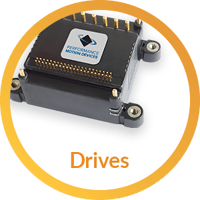
ION/CME N-Series Drives
ION®/CME N-Series Drives are high performance intelligent drives in an ultra-compact PCB-mountable package. In addition to advanced servo and stepper motor control, N-Series IONs provide s-curve point to point profiling, field oriented control, downloadable user code, general purpose digital and analog I/O, and much more. These all-in-one devices make building your next machine controller a snap.
Learn more >>
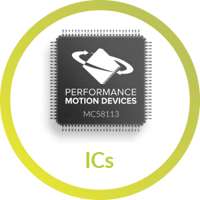
MC58113 Series ICs
The MC58113 series of ICs are part of PMD's popular Magellan Motion Control IC Family and provide advanced position control for stepper, Brushless DC, and DC Brush motors alike. Standard features include FOC (Field Oriented Control), trapezoidal & s-curve profiling, direct encoder and pulse & direction input, and much more. The MC58113 family of ICs are an ideal solution for your next machine design project.
Learn more >>
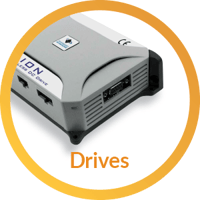
ION 500 & 3000 Drives
ION 500 and 3000 Drives are high performance intelligent drives in a compact cable-connected package. In addition to advanced servo motor control, IONs provide s-curve point to point moves, i2T power management, downloadable user code, and a range of safety functions including over current, over voltage, and over temperature detect. IONs are easy to use plug and play devices that will get your application up and running in a snap.
Learn more >>
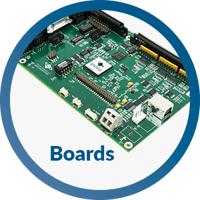
Prodigy/CME Machine Controller
Prodigy®/CME Machine Controller boards provide high-performance motion control for medical, scientific, automation, industrial, and robotic applications. Available in 1, 2, 3, and 4-axis configurations, these boards support DC Brush, Brushless DC, and stepper motors and allow user-written C-language code to be downloaded and run directly on the board. The Prodigy/CME Machine-Controller has on-board Atlas amplifiers that eliminate the need for external amplifiers.
Learn more >>
You may also be interested in:
- PMD Positioning Motion Control ICs Applications Summary (Article)
- Dusty Robotics N-Series Case Study (Case Study)
- Mathematics of Motion Control Profiles (Article)
- Build vs. Buy of a Three Axis Motion Controller (Article)