
 Case Studies

When Simplexity Product Development was hired by a medical device maker to support the next phase of a wearable assistive motion system, the mandate was clear: Take a promising proof-of-concept and make it a reliable, repeatable, clinical-ready system. That meant improving robustness, tightening control, reducing noise and wiring complexity, and choosing motion-control technology that could deliver precise torque control.
At the center of that effort was the Juno MC73113, a velocity and torque control IC from Performance Motion Devices (PMD). For Simplexity, the chip’s control capabilities mattered, but so did something less visible and often more critical: access to responsive, technically deep support during real-world bring-up and debugging.

Bridging the Gap Between Research and Reality
The product under development was a wearable robotic device intended for use in controlled clinical environments. Earlier versions of the system had been built largely as research platforms, using expensive, laboratory-grade hardware and software to demonstrate feasibility. The cost structure of the original design was too expensive to go to market.
“The customer had proven the concept, but they hadn’t developed production-grade hardware,” explains Eliza MacLeod, senior software/firmware engineer for Simplexity. “A lot of the original system was built around Arduino-level experimentation.” Simplexity’s role was to help turn that into something much more robust to demonstrate the device’s sophisticated features.
One of the core challenges was the original mechanical drive architecture itself. The electronics, motors, and gearboxes had been centralized to a belt pack, which required running long Bowden cables to the driven joint. The long cables made it more difficult for the patient to don the system and were a potential hazard for getting caught on things.
Simplexity’s approach combined mechanical, electrical, firmware, and system-level design, with a particular focus on motor control.
Why Torque Control Mattered
Unlike many motion-control applications that emphasize position or velocity, this device depended heavily on accurate torque control. The system had to assist motion smoothly and predictably, regulating motor torque while remaining stable and safe for human interaction.
With torque control, you don’t just want to command a value, explains Dave Hough, principal electrical engineer. “You want to give it torque and have it get there with reasonable accuracy,” he says. “And a lot of that depends on what you wrap around the controller, because torque is fundamentally related to motor currents.”
Simplexity evaluated multiple motor-control options before selecting PMD. The team narrowed the field to solutions that supported field-oriented control (FOC) and could integrate cleanly into an embedded system.
“FOC is an ideal solution for torque control across a broad range of use cases. The FOC calculations are dedicated to the task of maximizing motor torque at any current level,” MacLeod notes.
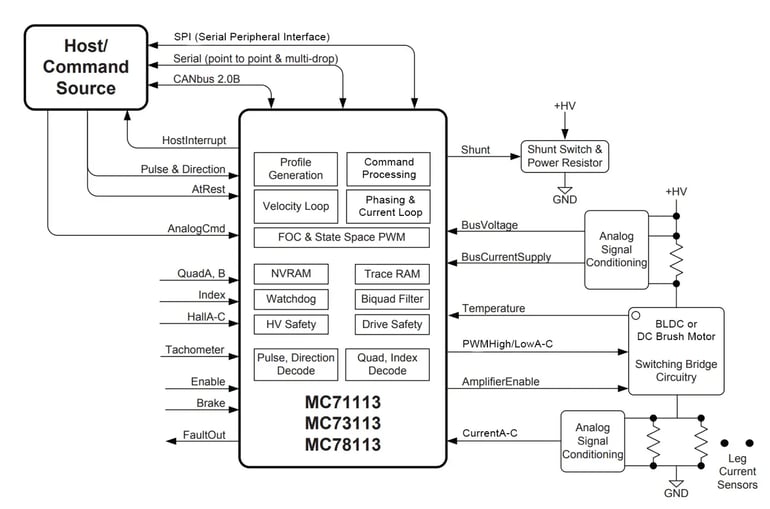
System Block Diagram - PMD Velocity Control ICs
“We were also looking to integrate quickly,” she adds. “Support was a big factor, along with the control sophistication we needed. PMD stood out for torque precision and the availability of example code we could build from.”
Cost and right-sizing also played a role. “The all-singing, all-dancing solution is a lot more expensive than a more targeted one,” Hough says. The MC73113 gave Simplexity’s engineers what they needed without unnecessary overhead.
Parallel Development With the PMD Development Kit
To move fast and provide the shortest possible schedule, Simplexity split hardware and firmware development paths. While Hough worked through board layout and component selection, MacLeod was able to begin firmware development using PMD’s development kit.
“That was extremely helpful,” MacLeod says. “It allowed me to start firmware development before I had access to the actual electronics.” It also allowed her to focus on learning the Juno chip’s parameters and behaviors, she adds.
The evaluation tools gave the team early visibility into parameterization, control loop behavior, and system response, which proved especially valuable given the number of variables involved in torque control and FOC configuration. “There are a lot of parameters involved with setting up torque control,” MacLeod notes, and the tools made it much easier to understand what needed to be configured and how everything interacted.
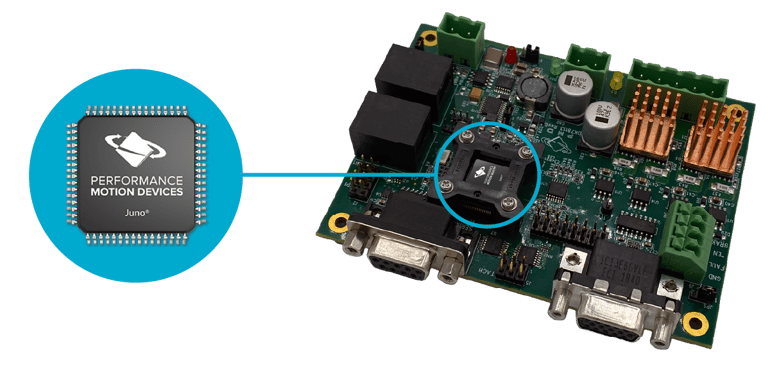
PMD's DK78113 Developer Kit
Although development kits are common in the industry, MacLeod emphasizes the usability of PMD’s software. “The interface was very handy. It let us interact with the chip early, experiment, and see how much it could do before we committed everything to our own board.”
Product Development and the Value of Expert Review
On the hardware side, Hough focused on building a minimal, efficient design around the MC73113. That meant making careful decisions about which pins and sensing features were truly required, and which could be omitted to simplify the design.
He was able to run schematics past PMD support to help with system configuration. “They helped confirm the minimum viable configuration and pointed out where adding extra sensing might be useful later,” Hough says.
This review process helped ensure that the board design aligned with the realities of the control IC, not just the datasheet.
Debugging Noise, Encoders, and Real-World Behavior
As the system moved from bench testing to operation under load, new challenges emerged. The motor would occasionally reverse direction unexpectedly, a serious issue in any human-interactive device.
“We were controlling it how we wanted it controlled, and then suddenly the motor would reverse directions,” MacLeod recalls. “The controller was confused because it wasn’t getting clean inputs.”
Hough traced part of the problem to encoder signaling. “In the past, I’d mostly used differential encoders,” he says. “Here, we were using a single-ended encoder to save cost and time, assuming the cable lengths would be short enough.” That assumption didn’t quite hold.
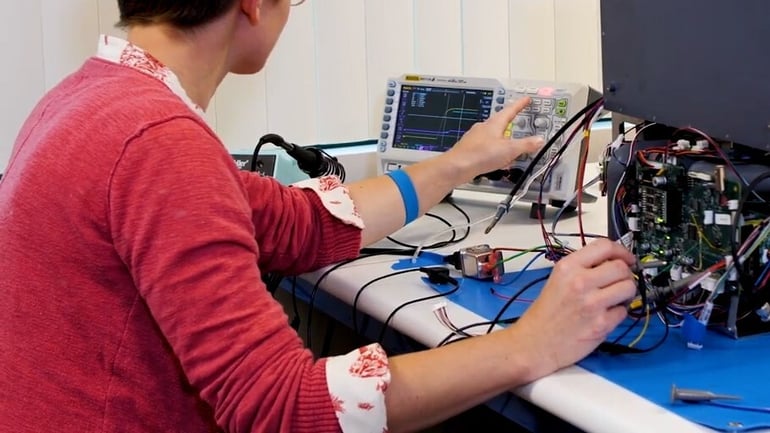
Development at Simplexity
PMD engineers worked closely with Simplexity to diagnose the issue, helping identify signal integrity problems related to encoder wiring and termination. With guidance on mitigation strategies, the team was able to stabilize feedback signals and restore predictable operation.
For MacLeod, having someone available to talk through the problem was invaluable. “Being able to call PMD, explain what we were seeing, and get concrete suggestions on what to check helped us resolve it much faster,” she says.
Once resolved, the benefits delivered by the Juno IC were immediately apparent.
With the MC73113 handling torque control via FOC, the motor ran significantly quieter than earlier prototypes, while delivering smooth, responsive torque exactly as commanded. Compared to the original research system, the improved design offered a much more refined and reliable user experience.
Designing for Speed Without Sacrificing the Future
The project’s immediate goal was to support demonstrations and near-term milestones, not full-scale commercialization. That influenced design decisions throughout the process.
“For demos and speed to market, it’s sometimes better to cut things down,” Hough explains. “You can remove a lot of overhead and paperwork and get something working faster, then build back up later.”
At the same time, Simplexity was careful not to paint the system into a corner. The MC73113’s capabilities leave room for future expansion, whether that means adding more sensing, refining control loops, or adapting the design for different usage scenarios.
A Strong Foundation for What Comes Next
By the end of the engagement, Simplexity had delivered a significantly cost-reduce and mechanically robust drive system, bringing the device one step closer to broader clinical use.
Looking back, both engineers point to PMD’s combination of control performance and support as a key factor in the project’s success. The Juno chip gave Simplexity the precision it needed, but the support made it possible to get there on schedule.
“Once you start system integration with real loads and real wiring, motion control sometimes has surprises that don’t show up in initial bench testing,” Hough notes. “Having PMD as a partner made those surprises manageable.”
For Simplexity, integrating PMD’s MC73113 wasn’t just about selecting a component. It was about choosing a motion-control partner that could support a complex, human-interactive system through design, development, debugging, and refinement.
As Simplexity continues to work on advanced electromechanical systems across medical, industrial, and consumer applications, PMD remains a proven partner for motion control designs that demand both performance and real-world practicality.
Juno Velocity Control ICs
Juno® MC71113, MC73113, and MC78113 ICs provide advanced velocity and torque control of Brushless DC and DC Brush motors. Available as a single one-axis IC, these products provide ultra efficient FOC control and are ideal for a wide range of medical, robotic, spindle and general motor control applications.
Learn more >>
You may also be interested in:
- Creative Conners Case Study (Case Study)
- Mathematics of Motion Control Profiles (Article)
- Build vs Buy of a Three Axis Motion Controller (Article)
- Ventilator Control (Motion Application)
- Field Oriented Control (FOC) - A Deep Dive (Article)