
 QuickBytes
Stepper motors are often selected for their simplicity, cost effectiveness, and brushless operation. Yet many of the issues commonly associated with stepper systems—excessive noise, vibration, missed steps, and overheating—are not inherent to the motor itself. They are frequently the result of how current is controlled.
In a stepper motor, torque is directly proportional to winding current. This makes current control the foundation of all downstream performance. As stepper-based systems are pushed toward higher accuracy, smoother motion, and quieter operation, traditional current control methods increasingly become a limiting factor.
This article explains how digital current loops fundamentally change stepper motor behavior. We’ll examine why current control matters, how digital current loops differ from legacy approaches, and how improved current regulation impacts noise, smoothness, efficiency, and overall system stability.
 To dive deeper, read the full article: How To Control Stepper Motors To dive deeper, read the full article: How To Control Stepper Motors |
Why Current Control Is Central to Stepper Motor Performance
Stepper motors are current-based devices. A stepper motor’s torque output is determined almost entirely by the magnitude and shape of the current flowing through its windings.
When current control is poor, several problems emerge:
- Torque ripple increases
- Mechanical vibration is excited
- Audible noise rises
- Motor temperature increases due to wasted energy
Because these effects originate at the electrical level, they cannot be fully corrected later through tuning or feedback. This makes current control the most critical—and often overlooked—element of stepper motor performance.
Traditional Stepper Motor Current Control
Current Chopper Drives
For many years, stepper motors have been driven using current chopper techniques. In a chopper drive, the controller applies the full bus voltage to a motor winding until the current reaches a preset threshold. Once that threshold is exceeded, the voltage is turned off for a fixed amount of time, allowing current to decay before the process repeats.
This approach is simple and inexpensive, but it has several inherent drawbacks:
- Large current ripple
- Poor regulation near zero current
- Audible noise caused by rapid current transitions
Chopper drives regulate current indirectly by switching voltage in an all-on or all-off manner, rather than continuously controlling current itself. As a result of these inherent drawbacks, the actual winding current often deviates significantly from the desired value—especially during microstepping.
What Is a Digital Current Loop?
A digital current loop regulates winding current using closed-loop control. Instead of switching voltage all on or all off based on a comparator, the controller continuously measures winding current and adjusts the applied voltage using a PI (Proportional–Integral) control loop.
Key characteristics of a digital current loop include:
- Continuous current regulation using Pulse Width Modulation (PWM)
- Accurate tracking of commanded current waveforms
- Stable behavior across the full motion operating range
Rather than approximating current with coarse switching, the controller actively drives the motor toward the desired current at every instant in time. This distinction has profound implications for stepper motor behavior.
Why Digital Current Loops Improve Microstepping
Microstepping relies on precisely controlling the ratio of currents between motor phases to create smooth, incremental motion. Any error in current magnitude or phase relationship directly translates into torque ripple and position nonlinearity.
With traditional chopper drives:
- Current waveforms are distorted
- Zero-crossings are poorly controlled
- Microstep linearity suffers
Digital current loops produce current waveforms that more closely match their ideal sinusoidal shape. This results in:
- Smoother torque production
- Reduced vibration at low speeds
- Improved positioning accuracy during microstepping.
Noise, Vibration, and Thermal Effects
One of the most visible benefits of digital current control is noise reduction. Electrical current ripple excites mechanical resonance in the motor and load. These vibrations manifest as audible noise and wasted mechanical energy.
By smoothing the current waveform, digital current loops:
- Reduce excitation of resonant frequencies
- Lower acoustic noise
- Decrease mechanical vibration
Importantly, quieter operation is not merely a cosmetic improvement. Vibration represents energy that is not contributing to useful motion. Reducing vibration also reduces motor heating and improves efficiency.
This relationship between current control, noise, and temperature is explored in depth in PMD’s article Digital Current Loop Significantly Quiets Step Motor Noise, which demonstrates how improved current regulation leads directly to cooler, quieter operation.
Current Control in Open-Loop vs Closed-Loop Steppers
Closed-loop steppers add position feedback, allowing the controller to correct for lost steps and disturbances. While this improves accuracy, it does not eliminate the need for high-quality current control.
Even in closed-loop systems:
- Torque is still generated by current
- Smoothness depends on current waveform quality
- Noise and heating originate at the electrical level
Feedback can correct position error, but it cannot remove torque ripple or electrical noise after the fact. This is why digital current control remains critical in both open-loop and closed-loop stepper architectures.
| For broader motor selection context, read the article: Closed Loop Stepper vs. Servo: How To Choose |
Measuring and Validating Current Loop Performance
Because current loops operate at high bandwidth, their behavior is not always obvious from external observation alone. Measurement tools that expose internal variables are essential for validation.
Useful signals to observe include:
- Commanded phase current
- Measured phase current
- Current error over time
By examining these variables, engineers can:
- Identify instability or saturation
- Verify microstepping accuracy
- Correlate electrical behavior with mechanical noise
Tools such as motion trace allow these internal parameters to be captured and analyzed, providing direct insight into how current control affects real-world performance.
| To learn more about motion trace, see: How To Optimize Motor Performance Using Motion Trace |
Practical Design Considerations
Implementing effective digital current control requires attention to several design factors:
- Bus voltage: Higher voltage improves current response but increases switching stress
- PWM frequency: Must balance resolution, efficiency, and EMI
- Thermal design: Smoother current reduces heat but does not eliminate thermal constraints in the motor
These considerations reinforce the importance of treating current control as a system-level design problem rather than a single configuration parameter.
Summary: Why Digital Current Loops Deserve More Attention
Stepper motors are capable of far more performance than many legacy systems deliver. In most cases, the limiting factor is not the motor—it is the current control method.
Digital current loops improve stepper motor performance by:
- Producing smoother torque
- Reducing noise and vibration
- Improving microstepping accuracy
- Lowering motor temperature
- Simplifying downstream control tuning
As motion systems demand higher precision and quieter operation, digital current control is no longer optional. It is a foundational requirement for modern stepper motor design.
PMD Products That Control Stepper Motors
PMD has been producing ICs that provide advanced motion control of DC Brush, Brushless DC, and stepper motors for more than twenty-five years. Since that time, we have also embedded these ICs into plug and play modules and motion control boards. While different in packaging, all of these products are controlled by C-Motion, PMD's easy to use motion control language and are ideal for use in medical, laboratory, semiconductor, robotic, and industrial motion control applications.
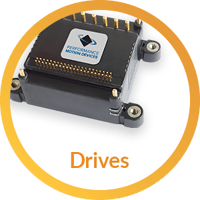
ION/CME N-Series Drives
ION®/CME N-Series Drives are high performance intelligent drives in an ultra-compact PCB-mountable package. In addition to advanced servo and stepper motor control, N-Series IONs provide s-curve point to point profiling, field oriented control, downloadable user code, general purpose digital and analog I/O, and much more. These all-in-one devices make building your next machine controller a snap.
Learn more >>
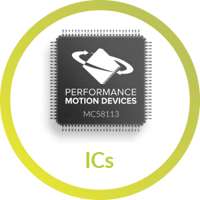
MC58113 Series ICs
The MC58113 series of ICs are part of PMD's popular Magellan Motion Control IC Family and provide advanced position control for stepper, Brushless DC, and DC Brush motors alike. Standard features include FOC (Field Oriented Control), trapezoidal & s-curve profiling, direct encoder and pulse & direction input, and much more. The MC58113 family of ICs are an ideal solution for your next machine design project.
Learn more >>
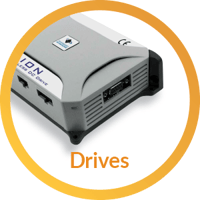
ION 500 & 3000 Drives
ION 500 and 3000 Drives are high performance intelligent drives in a compact cable-connected package. In addition to advanced servo motor control, IONs provide s-curve point to point moves, i2T power management, downloadable user code, and a range of safety functions including over current, over voltage, and over temperature detect. IONs are easy to use plug and play devices that will get your application up and running in a snap.
Learn more >>
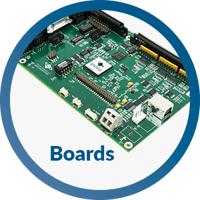
Prodigy/CME Machine Controller
Prodigy®/CME Machine Controller boards provide high-performance motion control for medical, scientific, automation, industrial, and robotic applications. Available in 1, 2, 3, and 4-axis configurations, these boards support DC Brush, Brushless DC, and stepper motors and allow user-written C-language code to be downloaded and run directly on the board. The Prodigy/CME Machine-Controller has on-board Atlas amplifiers that eliminate the need for external amplifiers.
Learn more >>
You may also be interested in:
- PMD Positioning Motion Control ICs Applications Summary (Article)
- OLogic Case Study - Robotics Design Firm (Case Study)
- ION/CME N-Series Drive Applications Summary (Article)
- Build vs. Buy of a Three Axis Motion Controller (Article)