
 QuickBytes
How Do You Prevent Stepper Motor Stall?
To prevent stepper motor stall, maintain sufficient torque margin across the operating speed range, limit acceleration to match the motor’s torque-speed curve, ensure accurate current regulation, avoid resonance regions, and implement closed-loop feedback when dynamic loads require position correction.
Stall is predictable when torque demand exceeds torque availability. Effective prevention requires torque-aware control — not guesswork.
What Causes Stepper Motor Stall
1. Insufficient Torque Margin
Available torque at operating speed is lower than required torque.
2. Excessive Acceleration
Acceleration demands peak torque before steady-state speed is reached.
3. Load Inertia Mismatch
High reflected inertia increases torque required during acceleration and deceleration.
4. Mid-Band Resonance
Mechanical resonance amplifies torque oscillation in a specific speed range.
5. Poor Current Regulation
Distorted phase current reduces effective torque production.
Stall is a control-system mismatch, not a random failure.
Symptoms of Stepper Motor Stall
Engineers troubleshooting stall often observe:
- Missed positioning or cumulative error
- Audible vibration or buzzing without rotation
- Sudden loss of motion during acceleration
- Increased motor temperature
- Intermittent motion instability
In open-loop systems, stall may occur without immediate detection.
Why Traditional Stall “Solutions” Often Fail
Common responses include:
- Increasing microstepping resolution
- Increasing supply voltage
- Using a larger motor
- Reducing maximum speed
These may reduce symptoms but do not address root cause.
Increasing Microstepping Resolution
Improves smoothness but does not increase available torque.

Increasing Voltage
Improves current rise time but does not increase steady-state torque beyond current limits.
Oversizing the Motor
Increases cost and inertia without correcting acceleration strategy.
Stall prevention must address torque demand and control strategy.
The Role of Load, Acceleration, and Torque
Stepper torque decreases with speed. Preventing stall requires evaluating the torque-speed curve under real load.
Required acceleration torque is:
Torque_required = J_total × angular_acceleration
Where J_total includes motor inertia plus reflected load inertia.
Quantified Example
If a stepper provides:
- 1.2 Nm at low speed
- 0.6 Nm at 1,200 RPM
And required torque during acceleration is 0.7 Nm at 1,200 RPM, stall will occur — even though static torque rating appears sufficient.
Reducing acceleration often prevents stall more effectively than reducing maximum speed.
Mid-Band Resonance and Stall Risk
Mid-band resonance typically occurs in the intermediate speed range of a stepper motor.
It is caused by interaction between:
- Motor inductance
- Rotor inertia
- Mechanical load characteristics
Resonance can amplify torque oscillation and increase stall probability.
Avoiding continuous operation in resonance regions or using damping and smoother motion profiles reduces risk.
Control-Based Stall Prevention Strategies
Effective stepper motor torque control strategies include:
1. Maintain Torque Margin
Design for at least 30–50% torque margin under worst-case load.
2. Use S-Curve Acceleration
Jerk-limited profiles reduce peak torque demand compared to abrupt trapezoidal profiles.
3. Avoid Resonance Speeds
Identify and avoid mid-band resonance zones.
4. Ensure Accurate Current Regulation
Torque is proportional to current. Distorted current reduces usable torque.
5. Match Inertia Carefully
Minimize reflected inertia where possible.
Motion control platforms such as the Magellan Motion Control IC family support advanced trajectory shaping to manage acceleration.
Stepper Motor Stall Causes and Corrective Actions
|
Root Cause |
Corrective Strategy |
|
Insufficient torque margin |
Increase motor torque or reduce load |
|
Excessive acceleration |
Use S-curve profiles or reduce acceleration |
|
Mid-band resonance |
Adjust operating speed or add damping |
|
Poor current regulation |
Use digital current loop control |
|
Inertia mismatch |
Reduce reflected inertia or gear appropriately |
Structured evaluation prevents reactive troubleshooting.
Digital Current Loop Advantages
Accurate current control directly improves torque fidelity.
Traditional current chopper drives introduce ripple that reduces effective torque.
Digital current loop regulation:
- Reduces ripple
- Improves zero-crossing accuracy
- Preserves usable torque margin
PMD testing shows smoother and more accurate current regulation compared to conventional chopper drives.
Improved current fidelity increases stall resistance.
Closed-Loop Stepper as a Stall-Prevention Tool
Open-loop systems cannot detect stall.
Closed loop stepper control adds encoder feedback and error correction.
|
Feature |
Open Loop |
Closed Loop |
|
Stall detection |
No |
Yes |
|
Position correction |
No |
Yes |
|
Dynamic torque adaptation |
No |
Yes |
|
Reliability margin |
Lower |
Higher |
Closed-loop systems convert stall from silent failure into detectable and correctable behavior.
Integrated solutions such as the Juno Step Motor Control IC family support closed-loop architectures.
When a Stepper May Not Be Appropriate
A stepper motor may not be suitable when:
- Continuous high-speed operation dominates
- Load inertia varies widely
- High-bandwidth contouring is required
In such cases, servo architectures may be more appropriate.
Stepper Motor Reliability and Production Risk
Undetected stall can:
- Propagate positioning error across batch processes
- Increase scrap rate
- Increase downtime
- Reduce system reliability
Improving stall resistance directly improves stepper motor reliability and production stability.
Practical Design Checklist
Use this checklist during system design:
✔ Verify torque margin across operating speeds
✔ Calculate acceleration torque requirement
✔ Use S-curve motion profiles
✔ Validate current regulation accuracy
✔ Identify resonance regions
✔ Evaluate inertia ratio
✔ Consider closed-loop stepper control for dynamic loads
Stall prevention is a system-level design responsibility.
Practical Design Checklist
- Stall occurs when torque demand exceeds available torque.
- Acceleration strategy is as important as motor sizing.
- Accurate current regulation preserves usable torque.
- Closed-loop control converts stall into a detectable condition.
- Torque margin, not microstep count, determines stall resistance.
Frequently Asked Questions
What is the main cause of stepper motor stall?
Stepper motor stall occurs when required torque exceeds available torque at a given speed or acceleration.
Does microstepping prevent stall?
No. Microstepping improves smoothness but does not increase available torque or detect position loss.
Is closed-loop control required to prevent stall?
Closed-loop control is not always required, but it significantly improves detection, correction, and reliability in dynamic applications.
Executive Summary
To prevent stepper motor stall, engineers must manage torque margin, acceleration demand, current regulation accuracy, and resonance behavior. Open-loop tuning alone is often insufficient. Digital current loop regulation improves usable torque, and closed-loop stepper control adds detection and correction capability for high-reliability systems.
Evaluation Guidance
When evaluating stall-resistant architectures:
- Analyze torque-speed curve under real load
- Validate acceleration torque requirements
- Confirm current regulation fidelity
- Assess whether closed-loop correction is required
Stall prevention is predictable when torque demand and control strategy are aligned.
PMD Products That Control Stepper Motors
PMD has been producing ICs that provide advanced motion control of DC Brush, Brushless DC, and stepper motors for more than twenty-five years. Since that time, we have also embedded these ICs into plug and play modules and motion control boards. While different in packaging, all of these products are controlled by C-Motion, PMD's easy to use motion control language and are ideal for use in medical, laboratory, semiconductor, robotic, and industrial motion control applications.
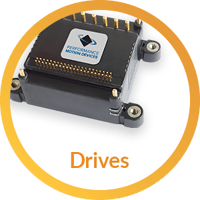
ION/CME N-Series Drives
ION®/CME N-Series Drives are high performance intelligent drives in an ultra-compact PCB-mountable package. In addition to advanced servo and stepper motor control, N-Series IONs provide s-curve point to point profiling, field oriented control, downloadable user code, general purpose digital and analog I/O, and much more. These all-in-one devices make building your next machine controller a snap.
Learn more >>
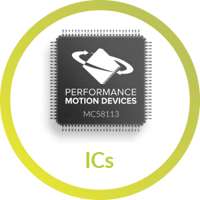
MC58113 Series ICs
The MC58113 series of ICs are part of PMD's popular Magellan Motion Control IC Family and provide advanced position control for stepper, Brushless DC, and DC Brush motors alike. Standard features include FOC (Field Oriented Control), trapezoidal & s-curve profiling, direct encoder and pulse & direction input, and much more. The MC58113 family of ICs are an ideal solution for your next machine design project.
Learn more >>
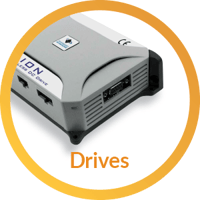
ION 500 & 3000 Drives
ION 500 and 3000 Drives are high performance intelligent drives in a compact cable-connected package. In addition to advanced servo motor control, IONs provide s-curve point to point moves, i2T power management, downloadable user code, and a range of safety functions including over current, over voltage, and over temperature detect. IONs are easy to use plug and play devices that will get your application up and running in a snap.
Learn more >>
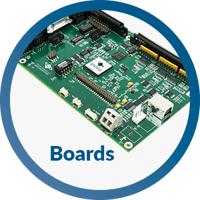
Prodigy/CME Machine Controller
Prodigy®/CME Machine Controller boards provide high-performance motion control for medical, scientific, automation, industrial, and robotic applications. Available in 1, 2, 3, and 4-axis configurations, these boards support DC Brush, Brushless DC, and stepper motors and allow user-written C-language code to be downloaded and run directly on the board. The Prodigy/CME Machine-Controller has on-board Atlas amplifiers that eliminate the need for external amplifiers.
Learn more >>
You may also be interested in:
- PMD Positioning Motion Control ICs Applications Summary (Article)
- OLogic Case Study - Robotics Design Firm (Case Study)
- ION/CME N-Series Drive Applications Summary (Article)
- Build vs. Buy of a Three Axis Motion Controller (Article)