
 QuickBytes
 For further analysis, read the full article: Feedforward Motion Control For further analysis, read the full article: Feedforward Motion Control |
Why Feedforward Matters
Many motion control systems achieve excellent performance using properly tuned PID control alone.
However, applications such as robotics, semiconductor equipment, medical devices, and precision automation often push servo systems closer to their performance limits. As machine speeds increase and positioning requirements become more demanding, engineers may find a limit to gains that can be achieved through PID tuning.
Common symptoms include:
- Following error during acceleration
- Longer settling times
- Reduced throughput
- Positioning errors during rapid moves
- Oscillation after increasing servo gains
These issues don't necessarily indicate that PID is poorly tuned. Instead, they often suggest that the controller is reacting to predictable system dynamics rather than anticipating them.
This is where feedforward motion control becomes valuable.
Rather than replacing PID, feedforward complements it by applying predictive compensation based on the commanded motion profile. The result is improved tracking accuracy, reduced following error, and smoother system performance without relying solely on increasingly aggressive feedback gains.
What Is Feedforward in Motion Control?
Feedforward in motion control is a control technique that anticipates predictable system behavior and applies corrective commands before position error develops.
Unlike PID control, which continuously reacts to measured error, feedforward uses information such as commanded velocity, acceleration, or trajectory to improve system response during motion.
Feedforward works alongside PID—not in place of it. By reducing predictable tracking errors before they occur, feedforward allows the feedback controller to focus on correcting unexpected disturbances and maintaining stable servo performance.
Key Motion Control Terms
PID Control
A closed-loop feedback algorithm that continuously adjusts motor output based on position error.
Feedforward
A predictive control method that applies compensation using commanded motion rather than measured error.
Following Error
The difference between the commanded trajectory and the motor's actual position while moving.
Motion Profile
The planned sequence of position, velocity, acceleration, and deceleration that defines a move.
Trajectory Generation
The process of calculating motion commands that produce smooth, coordinated movement.
Why Engineers Add Feedforward
High-performance machines frequently repeat the same motion profiles thousands—or even millions—of times.
Because these trajectories are predictable, many tracking errors are also predictable.
Rather than waiting for the servo loop to react after an error develops, feedforward proactively compensates for known system dynamics.
Engineers commonly implement feedforward to:
- Improve positioning accuracy
- Reduce following error
- Increase machine throughput
- Shorten settling time
- Improve repeatability
- Maintain stability while increasing performance
Key Insight
Feedforward doesn't replace PID—it helps reduce predictable motion errors before they occur.
By anticipating system dynamics, feedforward improves tracking accuracy while allowing the feedback controller to focus on correcting unexpected disturbances.
Five Signs PID Control May Not Be Enough
1. Following Error Increases During Acceleration
Many servo systems perform well at constant velocity but struggle during rapid acceleration or deceleration.
If following error consistently increases during dynamic motion, feedforward may improve trajectory tracking without requiring significantly higher PID gains.
2. Higher PID Gains Introduce Oscillation
Increasing proportional gain often reduces steady-state error—but only to a point.
If better accuracy comes at the expense of vibration, overshoot, or reduced stability margins, feedforward may provide a more balanced approach.
3. Machine Throughput Has Reached a Limit
As production speeds increase, servo systems have less time to correct motion errors.
Feedforward helps improve tracking during dynamic motion, allowing higher throughput while maintaining positioning accuracy.
4. Motion Performance Changes with Payload
Many machines experience different loading conditions throughout operation.
When these changes are predictable, feedforward can improve consistency without requiring multiple sets of servo gains.
5. Settling Time Is Limiting Productivity
Applications that require rapid indexing or repetitive positioning often depend on minimizing settling time.
Reducing following error during motion frequently allows the system to settle faster once the target position is reached.
How Feedforward Improves Motion Performance
Several feedforward techniques are commonly used depending on the motion system and application.
Velocity Feedforward
Compensates for predictable velocity-related tracking errors during constant-speed motion.
Acceleration Feedforward
Improves servo response during changes in velocity by compensating for inertial effects.
This is commonly used in robotics, semiconductor equipment, and high-speed pick-and-place systems.
Friction Compensation
Helps reduce predictable friction-related errors that affect low-speed positioning and repeatability.
PID Control vs. Feedforward Control
|
PID Control |
Feedforward Control |
|
Reacts after error occurs |
Anticipates predictable system behavior |
|
Uses feedback measurements |
Uses commanded motion information |
|
Corrects unexpected disturbances |
Reduces predictable tracking errors |
|
Essential for closed-loop stability |
Complements feedback control |
|
Continuously adjusts output |
Applies compensation proactively |
Why This Matters
Increasing PID gains is not always the most effective way to improve motion performance.
In many precision motion systems, combining properly tuned PID control with feedforward compensation allows engineers to improve tracking accuracy while maintaining stable servo behavior.
When Should Engineers Consider Feedforward?
Feedforward is often worth evaluating when:
- Motion profiles are highly repeatable.
- Positioning accuracy is becoming a limiting factor.
- Following error reduces machine throughput.
- Higher PID gains no longer improve performance.
- Multi-axis synchronization requires tighter tracking.
- Faster settling times are needed without compromising stability.
Applications such as robotics, semiconductor equipment, laboratory automation, and precision manufacturing frequently benefit from feedforward because they combine demanding performance requirements with highly repeatable motion profiles.
What Should Engineers Look for in Feedforward Support?
As motion systems become more sophisticated, engineers evaluating motion control platforms should consider not only motion performance specifications, but also the tools available for configuration, diagnostics, tuning, and long-term system optimization.
When evaluating feedforward capabilities, look for platforms that provide:
- Velocity and acceleration feedforward
- Straightforward tuning tools
- Integrated diagnostic tools
- Motion Trace for validating improvements
- t
- Coordinated multi-axis support
- Software that simplifies tuning and performance validation
These capabilities make it easier to optimize machine performance while reducing engineering effort throughout development and commissioning.
The PMD Difference
Implementing feedforward is only one part of optimizing a high-performance motion system. Engineers also need efficient tools to configure, tune, validate, and maintain that performance throughout a machine's lifecycle.
PMD's motion control platforms integrate trajectory generation, feedforward compensation, servo tuning, and diagnostic capabilities—including Motion Trace—within a unified development environment.
Rather than switching between multiple software tools or relying exclusively on trial-and-error tuning, engineers can configure control parameters, visualize system behavior, validate performance improvements, and refine machine operation using a consistent workflow.
For OEMs developing robotics, semiconductor equipment, medical devices, laboratory automation systems, and other precision motion applications, this integrated approach helps reduce engineering effort while making it easier to optimize performance from prototype through production.
Real-World Applications
Robotics
Improve path accuracy and cycle times during repetitive, coordinated motion.
Semiconductor Equipment
Reduce following error during high-speed positioning while maintaining precise stage control.
Medical Devices
Support smooth, repeatable motion for laboratory automation and diagnostic systems.
Precision Manufacturing
Increase throughput while maintaining positioning accuracy and repeatability.
Multi-Axis Motion Systems
Improve synchronized motion where multiple axes must follow complex trajectories simultaneously.
Key Takeaways
- Feedforward complements PID rather than replacing it.
- Feedforward helps reduce predictable tracking errors before they occur.
- Combining PID and feedforward often improves positioning accuracy without sacrificing stability.
- Motion Trace helps validate feedforward tuning using measured performance data.
- Engineers should evaluate both motion control capabilities and the supporting tuning and diagnostic tools.
- Integrated motion development workflows can simplify optimization throughout the machine lifecycle.
Frequently Asked Questions
What is feedforward motion control?
Feedforward motion control applies predictive compensation based on commanded motion to reduce tracking error before it develops.
Does feedforward replace PID control?
No. Feedforward complements PID by reducing predictable errors, while PID continues correcting unexpected disturbances and maintaining closed-loop stability.
When should feedforward be used?
Feedforward is commonly used in high-performance applications that require precise positioning, repeatable motion, and fast cycle times.
How does feedforward reduce following error?
By anticipating system dynamics and applying compensation before measurable error develops, feedforward improves trajectory tracking during dynamic motion.
How can engineers validate feedforward tuning?
Diagnostic tools such as Motion Trace allow engineers to compare commanded and actual motion, measure following error, and objectively verify tuning improvements.
Explore PMD Motion Control Solutions
Explore PMD's motion control solutions to learn how integrated feedforward, motion trace, servo tuning, and trajectory generation capabilities help simplify motion system optimization for precision applications.
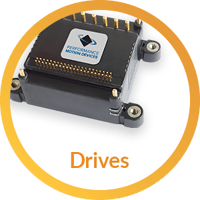
ION/CME N-Series Drives
ION®/CME N-Series Drives are high performance intelligent drives in an ultra-compact PCB-mountable package. In addition to advanced servo and stepper motor control, N-Series IONs provide s-curve point to point profiling, field oriented control, downloadable user code, general purpose digital and analog I/O, and much more. These all-in-one devices make building your next machine controller a snap.
Learn more >>
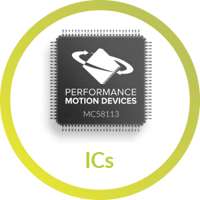
MC58113 Series ICs
The MC58113 series of ICs are part of PMD's popular Magellan Motion Control IC Family and provide advanced position control for stepper, Brushless DC, and DC Brush motors alike. Standard features include FOC (Field Oriented Control), trapezoidal & s-curve profiling, direct encoder and pulse & direction input, and much more. The MC58113 family of ICs are an ideal solution for your next machine design project.
Learn more >>
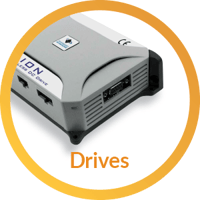
ION 500 & 3000 Drives
ION 500 and 3000 Drives are high performance intelligent drives in a compact cable-connected package. In addition to advanced servo motor control, IONs provide s-curve point to point moves, i2T power management, downloadable user code, and a range of safety functions including over current, over voltage, and over temperature detect. IONs are easy to use plug and play devices that will get your application up and running in a snap.
Learn more >>
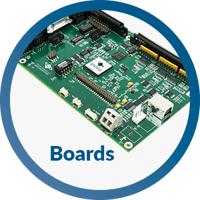
Prodigy/CME Machine Controller
Prodigy®/CME Machine Controller boards provide high-performance motion control for medical, scientific, automation, industrial, and robotic applications. Available in 1, 2, 3, and 4-axis configurations, these boards support DC Brush, Brushless DC, and stepper motors and allow user-written C-language code to be downloaded and run directly on the board. The Prodigy/CME Machine-Controller has on-board Atlas amplifiers that eliminate the need for external amplifiers.
Learn more >>
You may also be interested in:
- PMD Positioning Motion Control ICs Applications Summary (Article)
- OLogic Case Study - Robotics Design Firm (Case Study)
- ION/CME N-Series Drive Applications Summary (Article)
- Build vs. Buy of a Three Axis Motion Controller (Article)