
 QuickBytes
Engineering Context: Why Servo Vibration Matters in Precision Machines
Precision automation systems—such as semiconductor equipment, medical robotics, and high-accuracy assembly machines—often rely on BLDC servo motors to achieve smooth and repeatable motion. In these environments even small disturbances can degrade system performance.
Servo vibration may appear as:
- audible motor noise
- oscillation during acceleration or settling
- reduced positioning accuracy
- surface defects in manufacturing processes
Machine designers are often asked to improve motion smoothness while maintaining high dynamic performance. In many cases, vibration originates from interactions between motor torque production, control loop tuning, and mechanical resonance.
Reducing vibration therefore requires a system-level understanding of how electrical and mechanical dynamics interact in precision motion systems.
What Is Servo Vibration?
Servo vibration refers to oscillatory motion in a motor-driven system caused by interactions between control loops, torque generation, and mechanical dynamics. In BLDC servo systems, vibration often results from torque ripple, resonance in mechanical structures, or poorly tuned current and velocity loops.
When vibration occurs, the servo system repeatedly injects corrective motion commands. This behavior reduces positioning accuracy and can increase acoustic noise, mechanical wear, and system instability.
Key Motion Control Terms Related to Servo Vibration
Torque ripple
Torque ripple refers to periodic variations in motor torque caused by commutation methods, magnetic geometry, or current waveform distortion. Excessive ripple can excite mechanical resonance and create vibration in precision motion systems.
Mechanical resonance
Mechanical resonance occurs when a structure naturally oscillates at a specific frequency. If servo torque disturbances occur near this frequency, vibration amplitude can increase significantly.
Current loop bandwidth
Current loop bandwidth defines how quickly the motor controller can regulate phase current. Because torque is proportional to current, current loop dynamics strongly influence motion smoothness.
Feedforward control
Feedforward control anticipates system motion demands and applies corrective torque before errors occur. Proper feedforward tuning reduces the workload of the servo feedback loops, improves motion smoothness, and reduces tracking error.
Servo damping
Servo damping describes the ability of the control system to suppress oscillation in the mechanical system.
What Causes Servo Vibration?
Servo vibration usually arises from a combination of electrical and mechanical factors rather than a single root cause.
Common sources include:
- torque ripple from motor commutation
- mechanical resonance in structures or transmissions
- aggressive servo gain tuning
- insufficient current loop performance
- coupling between axes in multi-axis systems
- Abrupt changes in trajectory acceleration
Identifying the dominant vibration mechanism is the first step in improving motion smoothness.
Electromagnetic vs Mechanical Sources of Vibration
Servo vibration typically originates from two categories of disturbances.
Electromagnetic sources
Electromagnetic vibration is generated inside the motor or drive electronics.
Examples include:
- torque ripple from commutation
- current ripple from PWM switching
- instability in current loops
- rotor position estimation errors
These disturbances create torque fluctuations that propagate into the mechanical system.
Mechanical sources
Mechanical vibration originates from structural dynamics.
Common sources include:
- gear compliance
- belt elasticity
- structural resonance in machine frames
- load imbalance
Even small torque disturbances can excite these resonant modes.
Understanding whether vibration originates electrically or mechanically helps determine the appropriate corrective strategy.
Torque Ripple and Resonance Interaction
Torque ripple is a common contributor to servo vibration.
In BLDC motors, torque is generated through the interaction between stator current and rotor magnetic fields. Imperfect current waveforms or magnetic geometry can produce small periodic variations in torque output.
If these torque disturbances occur near the natural frequency of the mechanical system, resonance may amplify the vibration.
This interaction explains why:
- vibration may occur only at certain speeds
- vibration amplitude may increase with load
- resonance appears during acceleration or deceleration
Reducing torque ripple or shifting resonance frequencies can significantly improve motion smoothness.
How Current Loop Performance Affects Motion Smoothness
The current loop directly controls the torque output of a BLDC motor.
If current regulation is slow or unstable:
- torque commands may overshoot or oscillate
- disturbances are not rejected quickly
- ripple in the current waveform increases
A well-tuned current loop improves smoothness by ensuring the commanded torque is delivered accurately.
A common engineering rule of thumb is that current loop bandwidth should be significantly higher than velocity loop bandwidth so that torque commands are executed without delay.
Poor current loop tuning is therefore a frequent cause of servo vibration.
Feedforward and Compensation Methods
Feedforward control techniques can significantly improve motion smoothness by reducing tracking error and minimizing disturbance amplification.
Common feedforward techniques include:
Velocity feedforward
Applies torque proportional to commanded velocity to reduce steady-state tracking error.
Acceleration feedforward
Adds torque proportional to commanded acceleration, helping the motor respond quickly to trajectory changes.
 To learn more, read the article: Feedforward in Motion Control To learn more, read the article: Feedforward in Motion Control |
Friction compensation
Offsets predictable friction forces that can cause oscillation during low-speed motion.
These methods reduce the burden on feedback loops and help prevent oscillation caused by aggressive servo gains.
Structural Damping and Filtering
Mechanical resonance can also be addressed through structural, control-system damping, or trajectory profile modification techniques.
Structural damping
Mechanical design improvements may include:
- stiffening machine frames
- reducing compliance in couplings or belts
- redistributing mass
These changes shift resonance frequencies and reduce vibration amplification.
Digital filtering
Control systems may include filters designed to suppress resonance.
Examples include:
- notch filters targeting specific resonance frequencies
- biquad filters used in advanced motion controllers
These filters attenuate vibration without significantly affecting overall system bandwidth.
Trajectory Optimization
Abrupt changes in commanded acceleration inject resonant energy into the load.
To handle this:
● Use S-curve profiling which avoids instantaneous acceleration changes
Even a small amount of “S” can dramatically reduce vibrational energy injected into the driven mechanism.
| To dive deeper, read the full article: S-Curve Motion Profiles |
Precision Validation Methods
Diagnosing vibration requires measurement tools capable of observing motion dynamics.
Engineers typically use diagnostic methods such as:
- motion trace or high-speed data capture
- frequency response analysis
- step response measurements
- spectral vibration analysis
These tools allow engineers to identify vibration frequencies and determine whether the disturbance originates from torque ripple, resonance, or control loop instability.
Comparison: Electrical vs Mechanical Vibration Sources
|
Source Type |
Typical Cause |
Correction Strategy |
|
Electromagnetic |
Torque ripple or current loop instability |
Improve current loop tuning |
|
Mechanical |
Structural resonance |
Increase stiffness, apply filters, or adjust trajectory profiles |
|
Control interaction |
Excessive servo gain |
Adjust loop tuning |
|
Commutation artifacts |
Imperfect torque waveform |
Improve commutation strategy |
Practical Checklist to Reduce Servo Vibration
Engineers troubleshooting servo vibration can follow a structured workflow:
- Inspect current loop performance
Verify that the current loop responds quickly and without oscillation. - Evaluate torque ripple sources
Review commutation method and current waveform quality. - Identify mechanical resonance
Observe vibration frequency and compare with structural resonance. - Review servo loop tuning
Excessive velocity or position gains may excite oscillation. - Apply feedforward compensation
Reduce tracking error during acceleration and deceleration. - Add filtering if necessary
Notch or biquad filters can suppress resonance modes. - Use S-curve shaped velocity profiles
Even a small transition phase from one acceleration value to the next can reduce injected vibrational energy.
Following this systematic process helps isolate and correct vibration sources.
Why Modern Digital Drives Improve Motion Smoothness
Modern motion control architectures integrate current control, servo loops, and diagnostic tools into unified digital platforms.
Digital drive architectures provide:
- high-bandwidth current control
- deterministic loop timing
- advanced filtering and compensation
- real-time motion diagnostics
- Advanced profiling capabilities
Platforms such as ION drives and Magellan motion control ICs support these capabilities and allow engineers to analyze and tune motion systems directly. Integrated architectures make it easier to observe torque ripple, adjust current loop behavior, and apply filtering techniques to improve precision motion performance.
Key Takeaways: Reducing Servo Vibration
- Servo vibration often results from interactions between torque ripple and mechanical resonance.
- Current loop performance strongly influences motion smoothness.
- Mechanical compliance can amplify small torque disturbances.
- Feedforward compensation reduces the burden on feedback loops.
- Digital filtering and structural damping can suppress resonance modes.
Reducing vibration requires addressing both electrical control behavior and mechanical system dynamics.
FAQ
What causes servo vibration in BLDC systems?
Servo vibration typically results from torque ripple, mechanical resonance, poor servo tuning, or unstable current loops.
How can servo vibration be reduced?
Reducing vibration requires improving current loop tuning, identifying resonance frequencies, applying feedforward compensation, and using filters or mechanical damping where necessary.
Why does torque ripple cause vibration?
Torque ripple introduces periodic disturbances in the motor output. When these disturbances align with mechanical resonance frequencies, vibration amplitude increases.
PMD Products that can Reduce Vibration in Your System
PMD has been producing ICs that provide advanced motion control of DC Brush, Brushless DC, and stepper motors for more than twenty-five years. Since that time, we have also embedded these ICs into plug and play modules and motion control boards. While different in packaging, all of these products are controlled by C-Motion, PMD's easy to use motion control language and are ideal for use in medical, laboratory, semiconductor, robotic, and industrial motion control applications.
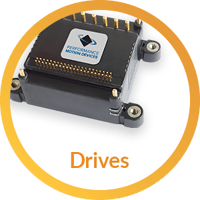
ION/CME N-Series Drives
ION®/CME N-Series Drives are high performance intelligent drives in an ultra-compact PCB-mountable package. In addition to advanced servo and stepper motor control, N-Series IONs provide s-curve point to point profiling, field oriented control, downloadable user code, general purpose digital and analog I/O, and much more. These all-in-one devices make building your next machine controller a snap.
Learn more >>
MC58113 Series ICs
The MC58113 series of ICs are part of PMD's popular Magellan Motion Control IC Family and provide advanced position control for stepper, Brushless DC, and DC Brush motors alike. Standard features include FOC (Field Oriented Control), trapezoidal & s-curve profiling, direct encoder and pulse & direction input, and much more. The MC58113 family of ICs are an ideal solution for your next machine design project.
Learn more >>
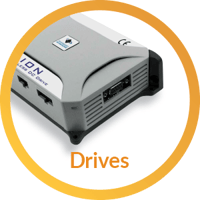
ION 500 & 3000 Drives
ION 500 and 3000 Drives are high performance intelligent drives in a compact cable-connected package. In addition to advanced servo motor control, IONs provide s-curve point to point moves, i2T power management, downloadable user code, and a range of safety functions including over current, over voltage, and over temperature detect. IONs are easy to use plug and play devices that will get your application up and running in a snap.
Learn more >>

Prodigy/CME Machine Controller
Prodigy®/CME Machine Controller boards provide high-performance motion control for medical, scientific, automation, industrial, and robotic applications. Available in 1, 2, 3, and 4-axis configurations, these boards support DC Brush, Brushless DC, and stepper motors and allow user-written C-language code to be downloaded and run directly on the board. The Prodigy/CME Machine-Controller has on-board Atlas amplifiers that eliminate the need for external amplifiers.
Learn more >>
You may also be interested in:
- PMD Positioning Motion Control ICs Applications Summary (Article)
- OLogic Case Study - Robotics Design Firm (Case Study)
- ION/CME N-Series Drive Applications Summary (Article)
- Build vs. Buy of a Three Axis Motion Controller (Article)