
 QuickBytes
What Is Microstepping?
Microstepping explained: Microstepping is a stepper motor control method that subdivides a full mechanical step into smaller commanded increments by applying sinusoidal phase currents to the motor windings.
In a typical 1.8° stepper motor (200 full steps per revolution):
- Full step = 1.8°
- 1/10 microstepping = 0.18° per commanded microstep
- 1/16 microstepping = 0.1125° per commanded microstep
Microstepping increases commanded resolution. It does not automatically increase true mechanical accuracy.
That distinction is essential.
Does Microstepping Improve Accuracy?
Microstepping improves smoothness and reduces vibration, but it does not proportionally increase mechanical accuracy. True positional accuracy depends on torque linearity, load torque, friction, compliance, and current regulation quality.
Microstepping increases resolution of command — not guaranteed rotor position precision.
What Microstepping Is — and What It Is Not
Microstepping works by controlling phase currents such that:
- Phase A follows a sine waveform
- Phase B follows a cosine waveform
This produces a rotating magnetic field that transitions smoothly between full-step positions.
Microstepping is:
- A torque vector control technique
- A smoothness enhancement method
- A resonance mitigation tool
Microstepping is not:
- Encoder-based position correction
- A method to increase torque
- A guarantee of linear rotor movement
The rotor position is governed by magnetic torque equilibrium — not by commanded subdivision alone.
Why Microstepping Improves Stepper Motor Smoothness
Full-step excitation produces discrete torque transitions, which can cause:
- Mechanical vibration
- Acoustic noise
- Resonance excitation
Microstepping reduces abrupt torque transitions by gradually shifting current between phases. This results in improved stepper motor smoothness, especially at low speeds.
However, smoothness improvement depends heavily on accurate phase current regulation. Distorted current waveforms reduce microstepping effectiveness.

Microstepping vs Full Step
|
Characteristic |
Full Step |
Microstepping |
|
Commanded resolution |
1.8° (typical) |
Fractional step |
|
Torque per increment |
Maximum |
Reduced |
|
Smoothness |
Moderate |
Improved |
|
Resonance excitation |
Pronounced |
Reduced |
|
Holding torque (static) |
High |
Similar overall |
Resolution vs Accuracy (The Critical Distinction)
Stepper Motor Resolution
Resolution refers to the smallest commanded angular increment.
Example:
A 1.8° motor at 1/16 microstepping produces 0.1125° commanded increments.
Microstepping Accuracy
Accuracy refers to how closely the rotor physically moves to that increment.
The rotor does not move in perfect linear increments between full steps. Instead, it follows the nonlinear magnetic torque curve. Microsteps subdivide the electrical command, but mechanical position is determined by torque equilibrium.
Quantified Example
If rotor position error within a full step is ±5% of 1.8° under load:
±0.09° error may occur regardless of whether 1/16 or 1/32 microstepping is used.
This illustrates why increasing microstep count does not proportionally increase real mechanical accuracy.
Common Microstepping Misconceptions
|
Myth |
Reality |
|
Microstepping increases positional accuracy proportionally |
It increases commanded resolution, not guaranteed rotor accuracy |
|
More microsteps always mean smoother motion |
Benefits diminish beyond practical mechanical limits |
|
Microstepping increases torque |
Incremental torque per microstep is reduced but overall torque delivered by the motor is similar |
|
Microstepping prevents stall |
It may reduce tendency to stall but does not detect or correct stall in open-loop systems |
Clarifying these misconceptions builds realistic performance expectations.
Where Microstepping Breaks Down
Microstepping benefits diminish under certain conditions:
Friction
Small microsteps may not generate sufficient incremental torque to overcome friction.
Mechanical Compliance
Backlash and compliance mask microstep-level precision.
Poor Current Regulation
Inaccurate current control distorts sine/cosine waveforms, reducing smoothness and positional stability.
High Speed Operation
At higher speeds, inductance limits current rise time, reducing waveform fidelity.
Microstepping is most effective at low to moderate speeds with adequate torque margin.
Diminishing Returns at High Microstep Ratios
Beyond 1/16 or 1/32 microstepping:
- Incremental torque becomes very small
- Load friction dominates motion
- Mechanical repeatability limits resolution
- Controller command resolution exceeds mechanical system capability
In many practical systems, increasing subdivision beyond these ratios yields minimal real-world improvement.
Interaction with Current Control
Microstepping accuracy depends directly on stepper motor current control quality.
If phase currents are distorted:
- Torque vector accuracy degrades
- Smoothness benefits decrease
- Low-speed stability suffers
Digital current loop regulation improves microstepping fidelity by reducing ripple and improving zero-crossing accuracy.
Microstepping performance should always be evaluated alongside current regulation architecture.
Microstepping vs Closed-Loop Control
Microstepping is an open-loop technique.
Closed-loop stepper control adds encoder feedback and position correction.
|
Feature |
Microstepping (Open Loop) |
Closed Loop Stepper |
|
Encoder required |
No |
Yes |
|
Smoothness improvement |
Yes |
Yes |
|
Position error correction |
No |
Yes |
|
Stall detection |
No |
Yes |
|
Dynamic performance |
Limited |
Improved |
Microstepping improves smoothness but does not correct position error or prevent stall. Closed-loop control addresses those limitations.
Reliability Implication
Reduced vibration from microstepping can lower:
- Noise generation
- Induced vibration
- Bearing wear
- Fastener loosening
- Structural fatigue
- Acoustic fatigue in enclosures
However, these reliability benefits depend on proper current waveform implementation.
Why Microstepping Ratio Alone Should Not Drive Specification Decisions
Many specifications emphasize microstep resolution (e.g., “256 microsteps per step”) without evaluating:
- Current waveform accuracy
- Load torque margin
- Mechanical repeatability
- Current regulation architecture
Resolution claims without context can misrepresent achievable performance.
For internal approval discussions, microstepping implementation quality is more important than subdivision ratio alone.
Practical Recommendations
Microstepping is most beneficial when:
- Reducing vibration and noise is important
- Operating at low to moderate speeds
- Load torque is well below holding torque
- Smooth indexing is required
Microstepping is less effective when:
- Load torque approaches motor limits
- Mechanical backlash dominates
- High-speed operation is primary
- Absolute accuracy requirements are strict
In such cases, closed-loop stepper or servo architectures may be more appropriate.
Implementation Considerations
Precision microstepping requires:
- Accurate current sensing
- Stable PWM current control
- Adequate torque margin
- Proper motor selection
Integrated motion ICs such as the MC54113Step Motor Control IC implement advanced microstepping control architectures.
Multi-axis control platforms such as the Magellan Motion Control IC family support precision trajectory generation integrated with microstepping control.
Microstepping effectiveness depends as much on implementation quality as on theoretical subdivision.
Executive Summary
Microstepping explained: Microstepping improves smoothness and reduces vibration by applying sinusoidal phase currents to subdivide full steps. It increases commanded resolution but does not proportionally increase mechanical accuracy. True performance depends on torque margin, friction, and current regulation quality.
Evaluation Guidance
When evaluating microstepping:.
- Distinguish resolution from accuracy
- Assess load torque margin
- Evaluate current regulation method
- Determine whether closed-loop correction is required
Microstepping primarily improves smoothness and resonance behavior. It should not be assumed to provide a similar increase in positional accuracy.
PMD Products That Control Stepper Motors
PMD has been producing ICs that provide advanced motion control of DC Brush, Brushless DC, and stepper motors for more than twenty-five years. Since that time, we have also embedded these ICs into plug and play modules and motion control boards. While different in packaging, all of these products are controlled by C-Motion, PMD's easy to use motion control language and are ideal for use in medical, laboratory, semiconductor, robotic, and industrial motion control applications.
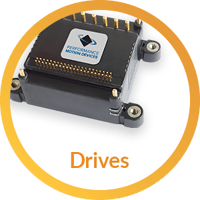
ION/CME N-Series Drives
ION®/CME N-Series Drives are high performance intelligent drives in an ultra-compact PCB-mountable package. In addition to advanced servo and stepper motor control, N-Series IONs provide s-curve point to point profiling, field oriented control, downloadable user code, general purpose digital and analog I/O, and much more. These all-in-one devices make building your next machine controller a snap.
Learn more >>
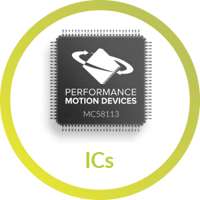
MC58113 Series ICs
The MC58113 series of ICs are part of PMD's popular Magellan Motion Control IC Family and provide advanced position control for stepper, Brushless DC, and DC Brush motors alike. Standard features include FOC (Field Oriented Control), trapezoidal & s-curve profiling, direct encoder and pulse & direction input, and much more. The MC58113 family of ICs are an ideal solution for your next machine design project.
Learn more >>
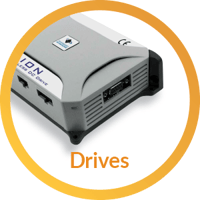
ION 500 & 3000 Drives
ION 500 and 3000 Drives are high performance intelligent drives in a compact cable-connected package. In addition to advanced servo motor control, IONs provide s-curve point to point moves, i2T power management, downloadable user code, and a range of safety functions including over current, over voltage, and over temperature detect. IONs are easy to use plug and play devices that will get your application up and running in a snap.
Learn more >>
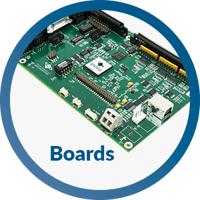
Prodigy/CME Machine Controller
Prodigy®/CME Machine Controller boards provide high-performance motion control for medical, scientific, automation, industrial, and robotic applications. Available in 1, 2, 3, and 4-axis configurations, these boards support DC Brush, Brushless DC, and stepper motors and allow user-written C-language code to be downloaded and run directly on the board. The Prodigy/CME Machine-Controller has on-board Atlas amplifiers that eliminate the need for external amplifiers.
Learn more >>
You may also be interested in:
- PMD Positioning Motion Control ICs Applications Summary (Article)
- OLogic Case Study - Robotics Design Firm (Case Study)
- ION/CME N-Series Drive Applications Summary (Article)
- Build vs. Buy of a Three Axis Motion Controller (Article)