
 QuickBytes
Engineering Context: Why the Open Loop vs Closed Loop Stepper Decision Matters
When selecting a motion architecture, machine designers are often balancing three forces:
- Cost
- Performance margin
- Risk of position loss
The open loop vs closed loop stepper decision directly impacts all three.
Open-loop stepper control has long been favored for its simplicity and low cost. It eliminates encoder feedback and servo tuning while delivering high holding torque at low speeds. However, as acceleration demands increase and dynamic loads become less predictable, its fundamental limitation becomes clear: there is no mechanism to detect or correct position error.
Closed-loop stepper control addresses this limitation by adding encoder feedback and a servo loop. The result is higher usable torque, stall immunity, and improved high-speed performance—often approaching that of brushless servo systems.
The critical question is not which architecture is “better.”
The question is:
Where does each architecture provide the best engineering tradeoff?
Architecture Snapshot: Open Loop vs Closed Loop Stepper
|
Feature |
Open Loop Stepper Control |
Closed Loop Stepper Control |
|
Encoder required |
No |
Yes |
|
Position correction |
None |
Continuous correction |
|
Stall detection |
No |
Yes |
|
Torque utilization |
Conservative (worst case margin required) |
As needed |
|
Tuning required |
Minimal |
Moderate (servo loop tuning) |
|
Cost |
Lower |
Higher |
|
Dynamic acceleration |
Limited by stall margin |
Significantly improved |
|
System complexity |
Low |
Medium |
|
Comparable to servo? |
No |
In some cases |
|
Heat Generation |
Higher |
Lower |
What Is Open Loop Stepper Control?
Open loop stepper control is a motion method where position is commanded without using feedback to verify actual rotor position. The controller assumes that each commanded step, or microstep, is executed accurately.
In this architecture:
- The trajectory generator outputs step pulses (or internally generated microsteps).
- The motor phases are energized according to a microstepping waveform.
- No encoder verifies motion.
Because no feedback loop exists, the system must be designed conservatively. Torque margins must be sufficient to guarantee that commanded steps are never missed.
To understand why this occurs, consider the torque production mechanism in a two-phase stepper. The rotor aligns with the stator magnetic field at equilibrium. As long as load torque remains below the pull-out torque curve, synchronization is maintained. If the load exceeds this threshold—even momentarily—the rotor slips and position is permanently lost.
There is no automatic recovery.
Torque-Speed Behavior in Open Loop Systems
Open-loop steppers exhibit:
- High holding torque at zero speed
- Torque drop-off as speed increases
- Reduced usable acceleration envelope
Designers typically derate maximum torque by 30–50% to avoid stall during dynamic moves.
This conservative design approach:
- Reduces system risk
- But sacrifices usable performance
What Is a Closed Loop Stepper Motor?
A closed loop stepper motor uses an encoder to measure rotor position and applies a servo control loop to correct position error in real time.
Rather than assuming steps are executed correctly, the controller:
- Measures actual rotor position
- Compares it to commanded position
- Adjusts current output to minimize position error
In effect, the motor is driven like a servo while retaining stepper magnetic construction.
Because of this:
- Stallrisk is eliminated
- Torque utilization improves
- Acceleration can be increased
- Position accuracy under load improves
- Motor heating is reduced
Closed-loop steppers are sometimes described as “servo-driven steppers,” though the magnetic structure remains distinct from a BLDC servo motor.
Control Structure in Closed Loop Steppers
A typical architecture includes:
- Trajectory generator (position, velocity, acceleration, jerk control)
- Position PID loop
- Current PI loop
- Power stage
The improvement is especially noticeable when:
- Rapid acceleration is required
- Loads are variable
- Compliance exists in the mechanical system
Unlike open-loop control, closed-loop systems can compensate for disturbance torque and recover from transient overload.
Microstepping vs Servo Control: A Critical Distinction
Microstepping is a feedforward current modulation technique that approximates sinusoidal phase currents to improve smoothness. Servo control uses feedback to actively minimize position error.
Microstepping improves:
- Vibration
- Audible noise
- Resolution
But it does not guarantee position accuracy under load.
Servo control improves:
- Accuracy
- Disturbance rejection
- Dynamic torque utilization
- Heat reduction in motor
This distinction is often misunderstood in stepper architecture comparison discussions.
Stall Behavior and Recovery
Open Loop Characteristics
When an open-loop stepper stalls:
- Rotor loses synchronization
- Position error accumulates instantly
- No automatic recovery occurs
- System must re-home or reset
This risk forces designers to include torque margin.
Closed Loop Characteristics
In closed-loop systems:
- Encoder detects deviation
- Controller increases torque output
- Recovery may occur automatically
- Fault flags can be triggered
Because stall is observable, acceleration limits can be pushed closer to theoretical torque capacity.
Encoder Requirements in Closed Loop Stepper Systems
Closed-loop systems require:
- Moderate to high resolution encoder
- Encoder resolution ≥ 4x microstep resolution
- Low latency feedback path
When using advanced motion ICs such as PMD’s Magellan®-based family, encoder input processing, trajectory generation, and current loop control are integrated at the silicon level, reducing latency and simplifying architecture.
 For a deeper architectural background, read: How To Control Stepper Motors For a deeper architectural background, read: How To Control Stepper Motors |
System Cost vs System Performance
|
Category |
Open Loop |
Closed Loop |
|
Motor cost |
Low |
Low |
|
Encoder |
Not required |
Required |
|
Controller complexity |
Low |
Higher |
|
Engineering time |
Low |
Moderate |
|
Performance |
Restricted |
Optimized |
|
Acceleration |
Limited |
High |
|
Throughput potential |
Moderate |
Higher |
|
Heat generation in motor |
Higher |
Lower |
The true cost comparison depends on:
- Required acceleration
- Load predictability
- Consequences of position loss
In applications such as:
- Pick-and-place
- Textile machinery
- PCB assembly
- Automated test systems
Closed-loop stepper often enables smaller motors to achieve higher throughput safely.
| For expanded discussion, read: Closed Loop Steppers Drive New Motion Control Applications |
When Does Closed Loop Stepper Approach BLDC Servo Territory?
Closed-loop stepper systems can approach BLDC servo performance when:
- Digital current loops tightly regulate coil current
- Position and velocity loops are properly tuned
- High-resolution encoders are applied
- Jerk-limited S-curve profiles are used
Under these conditions:
- Torque utilization increases
- Mid-range instability is reduced
- Audible noise drops
- High-speed performance improves
However, differences remain:
|
Characteristic |
Closed Loop Stepper |
BLDC Servo |
|
Magnetic structure |
Salient pole stepper |
Permanent magnet rotor |
|
High-speed efficiency |
Lower |
Higher |
|
Peak RPM |
Lower |
Higher |
|
Cost |
Lower to moderate |
Higher |
For many OEM applications below ~1500 RPM, closed-loop steppers can deliver comparable positioning performance at reduced system cost.
Practical Engineering Recommendations
Choose Open Loop Stepper When:
- Loads are predictable
- Acceleration is modest
- Stall risk is minimal
- Cost sensitivity is extreme
- Re-homing is acceptable
Choose Closed Loop Stepper When:
- Acceleration is high
- Load varies
- Position loss is unacceptable
- Thermal margin is limited
- Throughput drives revenue
- Minimum motor heating is desired
Current Loop Quality Matters
Modern digital current loops (PI-regulated PWM control) significantly reduce:
- Torque ripple
- Noise
- Heat generation
They are superior to legacy chopper-based current regulation methods, especially near zero-crossings of sinusoidal waveforms.
System-Level Takeaway
The open loop vs closed loop stepper decision is fundamentally about risk tolerance versus performance optimization.
Open loop:
- Simple
- Cost-effective
- Conservative
Closed loop:
- Higher dynamic capability
- Stall immunity
- Improved torque utilization
- Approaches servo performance in low to moderate speed applications
For systems where acceleration, throughput, or stall recovery materially affect machine value, closed-loop stepper architectures often represent the optimal engineering tradeoff.
Motion control IC platforms such as PMD’s MC58113 ICs, support both open-loop microstepping and fully closed-loop stepper control within the same silicon, enabling flexible architecture selection without redesigning the control core.
PMD Products That Control Stepper Motors
PMD has been producing ICs that provide advanced motion control of DC Brush, Brushless DC, and stepper motors for more than twenty-five years. Since that time, we have also embedded these ICs into plug and play modules and motion control boards. While different in packaging, all of these products are controlled by C-Motion, PMD's easy to use motion control language and are ideal for use in medical, laboratory, semiconductor, robotic, and industrial motion control applications.
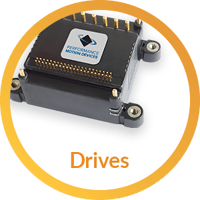
ION/CME N-Series Drives
ION®/CME N-Series Drives are high performance intelligent drives in an ultra-compact PCB-mountable package. In addition to advanced servo and stepper motor control, N-Series IONs provide s-curve point to point profiling, field oriented control, downloadable user code, general purpose digital and analog I/O, and much more. These all-in-one devices make building your next machine controller a snap.
Learn more >>
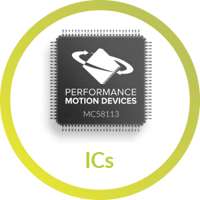
MC58113 Series ICs
The MC58113 series of ICs are part of PMD's popular Magellan Motion Control IC Family and provide advanced position control for stepper, Brushless DC, and DC Brush motors alike. Standard features include FOC (Field Oriented Control), trapezoidal & s-curve profiling, direct encoder and pulse & direction input, and much more. The MC58113 family of ICs are an ideal solution for your next machine design project.
Learn more >>
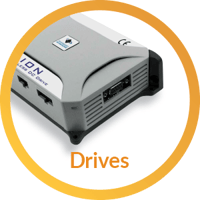
ION 500 & 3000 Drives
ION 500 and 3000 Drives are high performance intelligent drives in a compact cable-connected package. In addition to advanced servo motor control, IONs provide s-curve point to point moves, i2T power management, downloadable user code, and a range of safety functions including over current, over voltage, and over temperature detect. IONs are easy to use plug and play devices that will get your application up and running in a snap.
Learn more >>

Prodigy/CME Machine Controller
Prodigy®/CME Machine Controller boards provide high-performance motion control for medical, scientific, automation, industrial, and robotic applications. Available in 1, 2, 3, and 4-axis configurations, these boards support DC Brush, Brushless DC, and stepper motors and allow user-written C-language code to be downloaded and run directly on the board. The Prodigy/CME Machine-Controller has on-board Atlas amplifiers that eliminate the need for external amplifiers.
Learn more >>
You may also be interested in:
- PMD Positioning Motion Control ICs Applications Summary (Article)
- OLogic Case Study - Robotics Design Firm (Case Study)
- ION/CME N-Series Drive Applications Summary (Article)
- Build vs. Buy of a Three Axis Motion Controller (Article)