
 QuickBytes
Engineering Context: Why This Decision Matters
The trapezoidal commutation vs sinusoidal commutation vs FOC decision is not simply a firmware choice. It is a fundamental motor control architecture decision that affects:
- Torque ripple
- Acoustic noise
- Servo smoothness
- Thermal performance
- Processor requirements
- System cost
Machine designers are often asked to upgrade legacy trapezoidal BLDC systems to achieve smoother motion or lower noise. Robotics OEM teams frequently need higher dynamic precision. Industrial automation designers must balance performance with implementation complexity.
To understand the correct decision, we must move beyond marketing terminology and examine the physics and control theory underlying each method.
At the core, this is a comparison of BLDC commutation & phase control methods and how they manage magnetic flux alignment and current control.
What Is Trapezoidal Commutation?
Trapezoidal commutation is a BLDC control method that energizes motor phases in six discrete steps per electrical cycle, typically using Hall sensor feedback to switch current between phases at 60° intervals.
In trapezoidal control:
- Two phases are energized at a time
- One phase is floating
- Current waveform approximates a square shape
- Back-EMF is ideally trapezoidal
This method is sometimes called “six-step commutation.”
Why It Exists
Trapezoidal control is attractive because:
- Implementation is simple
- Processor requirements are low
- Hardware cost is minimal
- It works well at moderate speeds
However, because current transitions are abrupt, torque ripple occurs at each commutation event.
Mechanism of Torque Production in Trapezoidal Control
Torque is proportional to the cross-product of:
- Rotor magnetic flux
- Stator magnetic field
In trapezoidal control, the stator field rotates in discrete steps rather than smoothly. Therefore, the rotor experiences periodic torque variation.
The improvement in performance is limited because the magnetic flux angle cannot be continuously aligned.
What Is Sinusoidal Commutation?
Sinusoidal commutation drives the motor phases with continuously varying sinusoidal currents, reducing torque ripple compared to trapezoidal control but without full decoupling of torque and flux components.
Instead of square-like current waveforms, sinusoidal commutation:
- Generates smooth sine currents
- Reduces abrupt switching
- Improves acoustic noise
- Improves servo smoothness
However, it does not perform vector transformation into a rotating reference frame as true FOC does.
Sinusoidal control is often considered an intermediate improvement layer between trapezoidal and FOC.
What Is Field Oriented Control (FOC)?
Field Oriented Control (FOC) is a vector-based BLDC control method that transforms three-phase currents into a rotating d-q reference frame, allowing independent control of torque-producing and flux-producing components.
FOC uses:
- Clarke transformation
- Park transformation
- PI current loops in d-q axes
- Inverse transformations for PWM generation
This mathematical transformation aligns the control system with the rotor magnetic flux angle.
Because torque and flux are decoupled, FOC achieves:
- Minimal torque ripple
- Higher efficiency, especially at high speed
- Superior dynamic response
- Precise torque control
- Improved torque speed curve
Why Decoupling Matters
To understand why this occurs, consider that torque in a permanent magnet motor is proportional to q-axis current (Iq). The d-axis current (Id) influences magnetic flux.
In trapezoidal and sinusoidal methods:
- Flux and torque are indirectly coupled
- Optimization is limited
In FOC:
- Id and Iq are independently regulated
- Therefore torque can be maximized per ampere
This directly affects efficiency curves and thermal behavior.
What Is BLDC Torque Ripple?
BLDC torque ripple is the periodic variation in output torque caused by non-ideal commutation, phase current distortion, magnetic nonlinearity, and cogging effects.
Torque ripple manifests as:
- Mechanical vibration
- Audible noise
- Position error in servo systems
- Increased bearing wear
Ripple magnitude depends on:
- Commutation method
- Current loop bandwidth
- Back-EMF shape
- Mechanical compliance
Trapezoidal control exhibits the highest ripple.
FOC exhibits the lowest.
Trapezoidal Commutation vs Sinusoidal Commutation vs FOC: Core Comparison
|
Characteristic |
Trapezoidal |
Sinusoidal |
FOC |
|
Phase current shape |
Square |
Sinusoidal |
Vector-controlled sinusoidal |
|
Torque ripple |
High |
Moderate |
Low |
|
Acoustic noise |
Higher |
Reduced |
Minimal |
|
Efficiency |
Moderate |
Improved |
Highest |
|
Motion smoothness |
Limited |
Good |
Excellent |
|
Processor demand |
Low |
Moderate |
High |
|
Implementation complexity |
Low |
Medium |
High |
|
Flux-torque decoupling |
No |
No |
Yes |
Efficiency and Thermal Implications
Efficiency directly affects:
- Motor temperature
- Drive temperature
- Enclosure thermal constraints
Because trapezoidal control produces higher ripple and harmonic losses:
- Copper losses increase
- Iron losses increase
- Thermal rise increases
FOC improves efficiency because:
- Current aligns optimally with rotor flux
- Harmonic content is minimized
- Torque per ampere is maximized
- Current control loop de-coupled from rotation speed
The improvement is especially noticeable at high speeds where trapezoidal commutation without FOC results in lower efficiency and greater heat generation in the motor .
Acoustic Noise and Motion Smoothness Comparison
In robotics and laboratory automation:
- Acoustic noise is often a system-level constraint
- Smooth motion affects precision
Trapezoidal systems produce:
- Audible “buzzing” at commutation
- Mechanical oscillation
Sinusoidal control reduces audible content.
FOC further provides:
- High-speed efficiency
- Motor heating reduction
This is particularly important when FOC is integrated with advanced trajectory generation (S-curve profiles) and feedforward compensation techniques.
 For deeper system integration context, see: Feedforward in Motion Control For deeper system integration context, see: Feedforward in Motion Control |
Control Loop Architecture Breakdown
Trapezoidal
- Commutation state machine
- PWM voltage control or simple current control
Sinusoidal
- Phase angle measurement
- Sinusoidal reference generation
- PI current loops
FOC
- Clarke/Park transforms
- Dual PI current loops (Id/Iq)
- Inverse transform
- PWM modulation
FOC requires:
- High-speed ADC sampling
- Deterministic interrupt timing
- DSP-capable processor
Processor Demand and Complexity
FOC requires:
- Floating-point or optimized fixed-point math
- Fast control loop (typically 10–40 kHz)
- Real-time transformations
Machine designers upgrading from trapezoidal systems must evaluate:
- Controller bandwidth
- Controller memory
- Deterministic control timing
Motion IC platforms such as PMD’s MC58113 Series ICs integrate an advanced motion control architecture, reducing external processor burden and providing deterministic servo loop performance.
Application-Specific Decision Tree
Choose Trapezoidal When:
- Cost sensitivity is extreme
- Acoustic noise is not critical
- Smoothness is not precision-critical
- Legacy architecture exists
Choose Sinusoidal When:
- Noise must be reduced
- Smoothness improvement is needed
- Moderate performance gain is acceptable
- Processor resources are available
Choose FOC When:
- Highest performance is required
- Motion smoothness is critical
- Torque ripple must be minimized
- Drive efficiency matters in compact systems
- Thermal constraints are tight
Torque-Speed Curve Implications
In trapezoidal systems:
- Torque ripple increases under load
- Efficiency drops at high speeds
In FOC systems:
- Torque is linear with Iq
- Dynamic torque response improves
- High-speed efficiency improves
Because vector alignment is continuous, FOC maintains performance through the entire torque-speed envelope.
Bus Voltage Considerations
Higher bus voltage:
- Improves current rise time
- Enhances torque bandwidth
- Increases top rotation speed
Because FOC relies on precise current tracking, adequate bus voltage headroom is essential.
Integration with Feedforward and Advanced Control
FOC pairs naturally with:
- Acceleration feedforward
- Torque feedforward
- Cascaded position/velocity loops
- Jerk-limited profiles
Because torque is precisely controlled, feedforward techniques become more accurate.
This enables:
- Higher bandwidth
- Reduced servo error
- Improved positioning accuracy
System-Level Takeaway
The trapezoidal commutation vs sinusoidal commutation vs FOC decision ultimately reflects how precisely you need to control torque and how much ripple your system can tolerate.
Trapezoidal control:
- Simple
- Cost-effective
- Adequate for many industrial drives
Sinusoidal control:
- Improves smoothness
- Reduces noise
FOC:
- Decouples torque and flux
- Minimizes torque ripple
- Maximizes efficiency
- Enables precision servo performance
- Best torque speed curve
For robotics, precision automation, and systems upgrading from legacy trapezoidal drives, FOC often represents a measurable performance advancement.
PMD’s MC58113 ICs support advanced motion control architectures suitable for high-performance servo systems, providing deterministic control loops and integration with trajectory generation and feedforward techniques.
PMD Products That Control BLDC Motors
PMD has been producing ICs that provide advanced motion control of DC Brush, Brushless DC, and stepper motors for more than twenty-five years. Since that time, we have also embedded these ICs into plug and play modules and motion control boards. While different in packaging, all of these products are controlled by C-Motion, PMD's easy to use motion control language and are ideal for use in medical, laboratory, semiconductor, robotic, and industrial motion control applications.
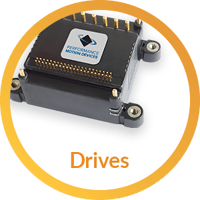
ION/CME N-Series Drives
ION®/CME N-Series Drives are high performance intelligent drives in an ultra-compact PCB-mountable package. In addition to advanced servo and stepper motor control, N-Series IONs provide s-curve point to point profiling, field oriented control, downloadable user code, general purpose digital and analog I/O, and much more. These all-in-one devices make building your next machine controller a snap.
Learn more >>
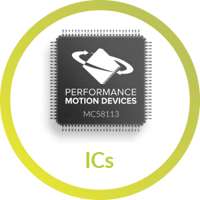
MC58113 Series ICs
The MC58113 series of ICs are part of PMD's popular Magellan Motion Control IC Family and provide advanced position control for stepper, Brushless DC, and DC Brush motors alike. Standard features include FOC (Field Oriented Control), trapezoidal & s-curve profiling, direct encoder and pulse & direction input, and much more. The MC58113 family of ICs are an ideal solution for your next machine design project.
Learn more >>
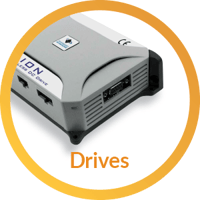
ION 500 & 3000 Drives
ION 500 and 3000 Drives are high performance intelligent drives in a compact cable-connected package. In addition to advanced servo motor control, IONs provide s-curve point to point moves, i2T power management, downloadable user code, and a range of safety functions including over current, over voltage, and over temperature detect. IONs are easy to use plug and play devices that will get your application up and running in a snap.
Learn more >>
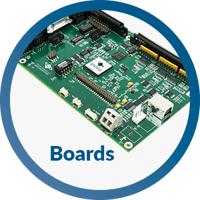
Prodigy/CME Machine Controller
Prodigy®/CME Machine Controller boards provide high-performance motion control for medical, scientific, automation, industrial, and robotic applications. Available in 1, 2, 3, and 4-axis configurations, these boards support DC Brush, Brushless DC, and stepper motors and allow user-written C-language code to be downloaded and run directly on the board. The Prodigy/CME Machine-Controller has on-board Atlas amplifiers that eliminate the need for external amplifiers.
Learn more >>
You may also be interested in:
- PMD Positioning Motion Control ICs Applications Summary (Article)
- OLogic Case Study - Robotics Design Firm (Case Study)
- ION/CME N-Series Drive Applications Summary (Article)
- Build vs. Buy of a Three Axis Motion Controller (Article)