
 QuickBytes
While this piece focuses on improving thermal performance in open loop stepper systems, it is important to recognize that closed loop stepper control is another effective way to address overheating. PMD explores these advantages in our article: Servo Performance with Step Motor Cost
Because many systems operate in open loop control mode, the techniques outlined below remain highly relevant for reducing overheating within those systems
Stepper motor overheating is one of the most common issues in compact motion systems. Engineers encounter it in:
- Laboratory automation equipment
- Medical devices
- Precision dispensing systems
- Semiconductor handling tools
- Compact multi-axis enclosures
The motor feels too hot to touch. Enclosure temperatures rise. Bearings wear prematurely. Noise increases. Reliability drops.
Machine designers are often asked:
“Is this temperature normal — or are we shortening system life?”
To understand why step motor heating occurs, we must begin with a fundamental principle:
A stepper motor is a current-driven device.
Heat is proportional to current squared (I²R losses).
Because most stepper systems regulate current rather than torque, overheating is frequently a control problem—not a motor problem.
Why Do Stepper Motors Get Hot?
Stepper motors get hot because they continuously draw phase current, even at standstill, and dissipate electrical energy as heat through winding resistance and magnetic losses. Unlike servo motors, they do not reduce current automatically when torque demand drops unless explicitly configured.
In open-loop systems, the motor is typically driven at rated current at all times. That means:
- At zero speed
- During holding
- During light-load moves
The motor consumes nearly constant electrical power.
Because electrical power becomes thermal energy, the motor housing temperature rises until heat dissipation equals heat generation.
How Hot Is Too Hot for a Stepper Motor?
Most stepper motors are rated for winding temperatures between 80°C and 130°C depending on insulation class. Surface temperatures of 60–90°C are common during normal operation. Exceeding rated winding temperature reduces insulation life and bearing longevity.
Important distinctions:
- Case temperature ≠ winding temperature
- Winding temperature may be 20–40°C higher than housing
- Insulation class determines safe limit
If the motor cannot be touched briefly (<2 seconds), it is likely above ~60°C.
For medical, laboratory, or enclosed applications, even 70°C case temperature may be unacceptable.
Therefore, thermal management is both a reliability issue and an application constraint issue.
Root Causes of Stepper Motor Heat
Stepper motor heat arises from five primary mechanisms:
1. Excess Current (I²R Losses)
Copper losses dominate thermal behavior.
If current is increased 20%, heat increases 44%.
Common causes:
- Over-rated current settings
- No idle current reduction
- Conservative torque margins
- Incorrect RMS current calculations
Because torque is proportional to current, designers often increase current to “be safe.”
The result is disproportionate heating.
2. Current Chopper Ripple
Legacy drives use a hysteretic “current chopper” method:
- Full bus voltage applied
- Current ramps upward
- Threshold reached
- Voltage removed
- Current decays
This produces:
- High ripple current
- Large current zero-crossing distortion
- Audible noise
- Additional RMS heating
Ripple increases effective RMS current beyond commanded value.
Therefore, even if average current appears correct, heating increases.
3. Inefficient Microstepping
Microstepping ideally generates sinusoidal phase currents.
However:
- Non-ideal regulation
- Quantization error
- Poor zero-crossing control
- Phase imbalance
Can lead to torque ripple and excess copper loss.
Torque ripple produces vibration.
Vibration represents mechanical energy that ultimately converts into heat.
4. Mechanical Vibration = Wasted Energy
When torque ripple excites mechanical resonance:
- Rotor oscillates
- Load vibrates
- Structural damping converts motion to heat
This energy does not produce useful work.
The improvement is especially noticeable when digital current loops reduce phase distortion at low speeds, where audible noise and vibration are typically worst.
5. Thermal Energy Pathways
Heat leaves the motor through:
- Conduction (mounting surface)
- Convection (airflow)
- Radiation
In compact enclosures:
- Airflow is limited
- Thermal stacking occurs
- Multi-axis heating compounds
Therefore, electrical inefficiency amplifies mechanical and enclosure constraints.
What Is Stepper Current Control?
Stepper current control is the method used by a drive to regulate phase current in the motor windings. It determines how accurately commanded current is delivered and directly affects torque production, noise, and heat generation.
There are two primary approaches:
- Hysteretic current chopper
- Digital PI (Proportional-Integral) current loop
The difference between these two methods strongly influences stepper motor temperature reduction.
Current Chopper vs Digital Current Loop
|
Feature |
Legacy Current Chopper |
Digital PI Current Loop |
|
Regulation method |
Hysteretic on/off |
Closed-loop PI |
|
Voltage applied |
Full bus pulses |
PWM-modulated |
|
Current ripple |
High |
Low |
|
Zero-crossing behavior |
Poor |
Precise |
|
Audible noise |
Higher |
Lower |
|
RMS heating |
Higher |
Lower |
|
Efficiency |
Lower |
Higher |
|
Thermal performance |
Elevated |
Improved |
How the Current Chopper Creates Extra Heat
Because full bus voltage is applied abruptly:
- Current ripple amplitude increases
- RMS current increases
- Switching losses increase
- Magnetic losses increase
Additionally, near zero-crossings, regulation becomes inaccurate, increasing distortion.
The result is higher stepper motor heat even when commanded current remains unchanged.
How a Digital Current Loop Reduces Stepper Motor Overheating
A digital current loop uses a PI controller:
- Measures actual phase current
- Compares to commanded value
- Adjusts PWM duty cycle proportionally
This produces:
- Smooth sinusoidal currents
- Lower ripple
- Accurate zero-crossing control
- Reduced harmonic distortion
Because ripple is minimized, RMS current aligns more closely with commanded current.
Therefore:
- Copper losses decrease
- Magnetic losses decrease
- Audible noise decreases
- Vibration decreases
- Stepper motor temperature reduction becomes measurable
As discussed in PMD’s digital current loop analysis article, improvements are especially noticeable in low-speed microstepping applications where noise and vibration are most problematic.
Stepper Control Thermal Comparison Chart
|
Operating Condition |
Chopper Drive |
Digital Current Loop |
|
Low-speed microstepping |
Audible buzz, elevated heat |
Quiet, cooler operation |
|
Standstill holding |
High ripple heating |
Lower ripple heating |
|
Compact enclosure |
Temperature stacking |
Improved margin |
|
Precision lab system |
Noise-sensitive |
Noise reduced |
|
Multi-axis system |
Thermal accumulation |
Reduced per-axis heat |
Practical Stepper Thermal Management Strategies
Electrical Fixes (Highest Impact)
1. Verify RMS Current Settings
- Confirm motor rated current
- Avoid peak-based overestimation
- Use RMS measurement
2. Enable Idle Current Reduction
Reduce current to 30–60% when stationary.
Holding torque often exceeds requirement.
3. Increase Bus Voltage (With Proper Control)
Higher voltage:
- Improves high-speed torque
- Shortens current rise time
- Reduces distortion
Requires digital current loop for safe regulation.
4. Switch to Digital Current Loop Drive
Reduces:
- Ripple
- Harmonics
- Thermal rise
- Audible noise
This is frequently the most effective solution.
Mechanical & Thermal Fixes
5. Improve Mounting Conduction
- Flat mounting surface
- Thermal interface material
- Metal chassis coupling
6. Provide Directed Airflow
Even 0.5 m/s airflow dramatically lowers case temperature.
7. Avoid Resonant Operating Regions
Resonance increases vibration and heating.
Consider:
- Acceleration profile tuning
- S-curve jerk limitation
- Microstep resolution adjustment
 For expanded discussion, read: How To Control Stepper Motors For expanded discussion, read: How To Control Stepper Motors |
Profile & Control Improvements
- Use S-curve trajectories to reduce jerk
- Minimize unnecessary holding time at full torque
- Confirm load inertia matching
Because acceleration torque contributes to RMS heating, optimizing motion profiles can reduce thermal load without changing hardware.
PMD Atlas Amplifier and Thermal Efficiency
Modern digital amplifiers such as PMD’s Atlas Amplifier integrate:
- High-bandwidth digital current loops
- Precision PWM control
- Advanced microstepping algorithms
- Motion IC compatibility
The improvement is especially noticeable in:
- Noise-sensitive medical equipment
- Laboratory automation
- Compact multi-axis enclosures
- Applications requiring low acoustic signature
Atlas-based systems demonstrate reduced ripple-induced heating compared to legacy chopper architectures.
(Reference: Atlas Digital Amplifier User Manual.)
System-Level Takeaway
Stepper motor overheating is rarely caused by “bad motors.”
It is usually caused by:
- Excess current
- Inefficient current regulation
- Ripple-induced RMS heating
- Mechanical resonance
- Poor enclosure heat rejection
The most impactful lever is often current control quality.
Because stepper motors are fundamentally current-driven devices, improving how current is regulated directly improves:
- Thermal performance
- Acoustic noise
- Mechanical stability
- Reliability
Digital PI current loops represent a meaningful advancement over legacy chopper control, particularly in compact, noise-sensitive, or precision environments.
PMD Products That Control Stepper Motors
PMD has been producing ICs that provide advanced motion control of DC Brush, Brushless DC, and stepper motors for more than twenty-five years. Since that time, we have also embedded these ICs into plug and play modules and motion control boards. While different in packaging, all of these products are controlled by C-Motion, PMD's easy to use motion control language and are ideal for use in medical, laboratory, semiconductor, robotic, and industrial motion control applications.
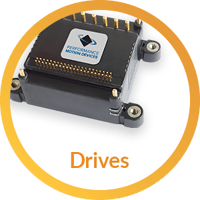
ION/CME N-Series Drives
ION®/CME N-Series Drives are high performance intelligent drives in an ultra-compact PCB-mountable package. In addition to advanced servo and stepper motor control, N-Series IONs provide s-curve point to point profiling, field oriented control, downloadable user code, general purpose digital and analog I/O, and much more. These all-in-one devices make building your next machine controller a snap.
Learn more >>
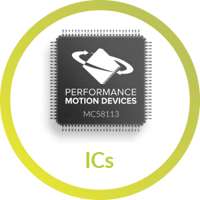
MC58113 Series ICs
The MC58113 series of ICs are part of PMD's popular Magellan Motion Control IC Family and provide advanced position control for stepper, Brushless DC, and DC Brush motors alike. Standard features include FOC (Field Oriented Control), trapezoidal & s-curve profiling, direct encoder and pulse & direction input, and much more. The MC58113 family of ICs are an ideal solution for your next machine design project.
Learn more >>
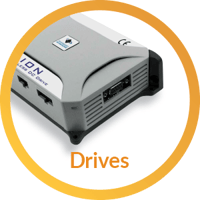
ION 500 & 3000 Drives
ION 500 and 3000 Drives are high performance intelligent drives in a compact cable-connected package. In addition to advanced servo motor control, IONs provide s-curve point to point moves, i2T power management, downloadable user code, and a range of safety functions including over current, over voltage, and over temperature detect. IONs are easy to use plug and play devices that will get your application up and running in a snap.
Learn more >>

Prodigy/CME Machine Controller
Prodigy®/CME Machine Controller boards provide high-performance motion control for medical, scientific, automation, industrial, and robotic applications. Available in 1, 2, 3, and 4-axis configurations, these boards support DC Brush, Brushless DC, and stepper motors and allow user-written C-language code to be downloaded and run directly on the board. The Prodigy/CME Machine-Controller has on-board Atlas amplifiers that eliminate the need for external amplifiers.
Learn more >>
You may also be interested in:
- PMD Positioning Motion Control ICs Applications Summary (Article)
- OLogic Case Study - Robotics Design Firm (Case Study)
- ION/CME N-Series Drive Applications Summary (Article)
- Build vs. Buy of a Three Axis Motion Controller (Article)