
 QuickBytes
For decades, the choice between stepper motors and servo motors seemed straightforward. Steppers were viewed as low-cost, simple solutions for moderate performance, while servos were reserved for applications demanding high speed, accuracy, and smooth motion.
That distinction is no longer so clear.
Advances in feedback, current control, and control-loop integration have led to the rise of closed-loop stepper systems, which now compete directly with servos in a growing number of applications. As a result, engineers are increasingly faced with a more nuanced question: when does a closed-loop stepper make sense, and when is a servo motor such as a brushless DC or DC brush motor still the better choice?
This article examines that question from a control-system perspective. Rather than focusing on motor labels or marketing claims, we’ll look at how torque is produced, how control loops behave, and how cost and performance tradeoffs play out in real machines.
 To dive deeper, read the full article: Principles of Motor Selection To dive deeper, read the full article: Principles of Motor Selection |
Why the Stepper vs Servo Decision Has Changed
Traditionally, stepper motors were attractive because they:
- Were inexpensive
- Did not require encoders
- Were easy to commission
Their drawbacks—vibration, noise, and limited speed—were accepted as part of the show.
Servo motors, by contrast, offered:
- Smooth, continuous torque
- High acceleration and speed
- Closed-loop accuracy
But they came with higher cost, more complex tuning, and additional system overhead.
Closed-loop steppers blur this line. By adding position feedback and improving current regulation, they address many of the historical weaknesses of stepper systems, making them viable for applications once dominated by servos.
What “Closed Loop” Means for Each Motor Type
Closed Loop Stepper Motors
A closed-loop stepper combines a traditional stepper motor with a feedback device, typically an encoder. The controller monitors actual position and corrects errors by continuously adjusting commanded current.
Key characteristics include:
- Discrete torque production based on stepper motor geometry
- Improved accuracy over open-loop steppers
- Elimination of missed steps and better disturbance rejection
While feedback improves performance, the underlying motor physics remain stepper-based. Torque is still produced through phase excitation patterns, which influences smoothness and dynamic response.
Servo Motors
Servo motors—often brushless DC motors—are designed to produce continuous torque over a wide speed range. Torque is directly proportional to current, and advanced control methods such as Field Oriented Control (FOC) allow precise regulation of that torque through the entire speed range.
Servo systems inherently rely on:
- High-bandwidth current loops
- Continuous feedback
- Position loop control or velocity loop control
Torque Production and Control Loop Behavior
The most meaningful difference between closed-loop steppers and servos lies in the number of motor poles typically found in each.
Stepper motors, with their high pole counts of 100 or more, effectively generate torque through discrete phase excitation. Even with feedback, torque output varies with rotor position. This can introduce ripple and resonance, especially at certain speeds.
Servo motors, by contrast, have much lower typical pole counts of 4 to 8 poles resulting in more stable torque production as a function of current. When paired with high-quality current control, this allows:
- Smoother motion
- Higher usable acceleration
- Better behavior under rapidly changing loads
That said, current loop quality matters for both systems. Poor current regulation can undermine even the best motor selection.
Modern digital current loops significantly improve stepper smoothness and noise performance, narrowing the gap between steppers and servos in many applications.
| To learn more, read: Digital Current Loops for Stepper Motors |
Accuracy, Smoothness, and Dynamic Response
Accuracy is often assumed to be a function of motor type, but in practice it is determined by:
- Encoder feedback resolution
- Control loop bandwidth
- Mechanical compliance
Closed-loop steppers can achieve excellent accuracy and repeatability, particularly in applications with predictable loads. However, at higher speeds or accelerations, torque ripple and resonance may still limit smoothness.
Servos typically excel in:
- High-speed motion
- Rapid acceleration and deceleration
- Applications requiring continuous smooth torque
In both cases, the interaction between control loops and mechanics plays a critical role. Smooth motion is often the result of good control design rather than simply choosing a “better” motor.
Tuning Complexity and Commissioning Effort
One practical difference between the two approaches is tuning effort.
Servo systems generally require:
- Careful tuning of current and velocity or position loops
- Attention to mechanical resonance and compliance
Closed-loop steppers often appear simpler to commission, particularly in applications where the mechanics are stiff and predictable. However, as performance demands increase, tuning complexity rises for both systems.
| To learn more, see: Servo Tuning 101 |
Cost vs Performance: A Control-System View
Motor cost alone rarely tells the full story. Engineers must consider:
- Encoder and cabling requirements
- Controller and drive complexity
- Commissioning time
- Long-term maintainability
Closed-loop steppers often provide an excellent balance when:
- Performance requirements are moderate to high
- Cost sensitivity is important
- Motion profiles are well defined
Servos remain the better choice when
- High continuous speeds are required
- Loads vary unpredictably
- The highest levels of smoothness and dynamic response are needed
In many cases, the deciding factor is not motor capability, but how effectively the control system can exploit that capability.
Application-Based Guidance
When Closed Loop Steppers Make Sense
- Cost-sensitive automation systems
- Compact machines with limited power budgets
- Applications with predictable dynamics
When Servos Are the Better Choice
- High-speed continuous motion
- High dynamic loading
- Applications where vibration and acoustic noise must be minimized
Choosing a Control Platform That Supports Both
For OEMs and machine builders, flexibility matters. Platforms that support both closed-loop stepper and servo control allow:
- Matching of the axis control requirements of the motor type
- Simplified long-term support
- Faster design iteration
Controllers and drives that share common control concepts—current loops, trajectory generation, and tuning tools—reduce development risk and future-proof designs.
Summary: Choose Based on Physics, Not Labels
The decision between a closed-loop stepper and a servo is no longer about “low-end vs high-end” motors. It is about understanding:
- How torque is produced
- How control loops interact
- How cost and performance tradeoffs align with application needs
By evaluating systems at the control-loop and architectural level, engineers can make informed decisions that balance performance, cost, and complexity—without relying on outdated assumptions.
PMD Products that Control Stepper and Servo Motors
PMD has been producing ICs that provide advanced motion control of DC Brush, Brushless DC, and stepper motors for more than twenty-five years. Since that time, we have also embedded these ICs into plug and play modules and motion control boards. While different in packaging, all of these products are controlled by C-Motion, PMD's easy to use motion control language and are ideal for use in medical, laboratory, semiconductor, robotic, and industrial motion control applications.
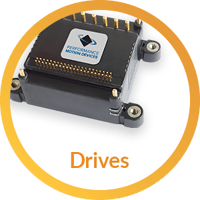
ION/CME N-Series Drives
ION®/CME N-Series Drives are high performance intelligent drives in an ultra-compact PCB-mountable package. In addition to advanced servo and stepper motor control, N-Series IONs provide s-curve point to point profiling, field oriented control, downloadable user code, general purpose digital and analog I/O, and much more. These all-in-one devices make building your next machine controller a snap.
Learn more >>
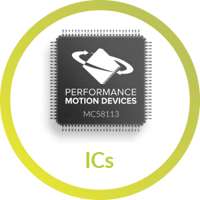
MC58113 Series ICs
The MC58113 series of ICs are part of PMD's popular Magellan Motion Control IC Family and provide advanced position control for stepper, Brushless DC, and DC Brush motors alike. Standard features include FOC (Field Oriented Control), trapezoidal & s-curve profiling, direct encoder and pulse & direction input, and much more. The MC58113 family of ICs are an ideal solution for your next machine design project.
Learn more >>
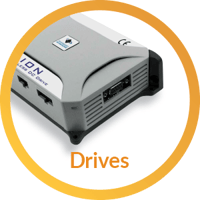
ION 500 & 3000 Drives
ION 500 and 3000 Drives are high performance intelligent drives in a compact cable-connected package. In addition to advanced servo motor control, IONs provide s-curve point to point moves, i2T power management, downloadable user code, and a range of safety functions including over current, over voltage, and over temperature detect. IONs are easy to use plug and play devices that will get your application up and running in a snap.
Learn more >>
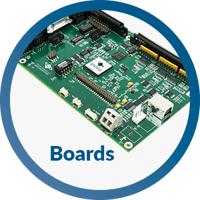
Prodigy/CME Machine Controller
Prodigy®/CME Machine Controller boards provide high-performance motion control for medical, scientific, automation, industrial, and robotic applications. Available in 1, 2, 3, and 4-axis configurations, these boards support DC Brush, Brushless DC, and stepper motors and allow user-written C-language code to be downloaded and run directly on the board. The Prodigy/CME Machine-Controller has on-board Atlas amplifiers that eliminate the need for external amplifiers.
Learn more >>
You may also be interested in:
- PMD Positioning Motion Control ICs Applications Summary (Article)
- OLogic Case Study - Robotics Design Firm (Case Study)
- ION/CME N-Series Drive Applications Summary (Article)
- Build vs. Buy of a Three Axis Motion Controller (Article)