
 QuickBytes
Why Current Loop Bandwidth Defines Servo Performance
When engineers attempt to increase the responsiveness of a BLDC servo system, they often begin by tuning the velocity loop or modifying trajectory profiles. In many cases, however, the real limitation is deeper in the control stack: the current loop.
In a BLDC motor, torque is directly proportional to phase current. Every torque command generated by the outer control loops must therefore pass through the current controller before it reaches the motor windings.
Because of this relationship, current loop bandwidth directly determines how quickly torque can be generated.
If current loop bandwidth is too low:
- Torque response becomes sluggish
- Velocity loop tracking error increases
- Disturbance rejection is weakened
If bandwidth is pushed too high:
- Electrical oscillation can occur
- Audible noise may increase
- Control instability may develop
Machine designers in robotics, semiconductor automation, and precision equipment frequently encounter this tradeoff when optimizing servo performance. Understanding how to properly tune current loop bandwidth is therefore essential for achieving stable, high-performance motion.
What Is Current Loop Bandwidth in BLDC Servo Systems?
Current loop bandwidth in a BLDC servo system is the frequency range over which the motor drive can accurately regulate phase current in response to commanded torque. Because torque in a BLDC motor is proportional to current, current loop bandwidth directly determines torque response speed and overall servo dynamic performance.
Higher current loop bandwidth enables:
- Faster torque response
- Improved disturbance rejection
- Better motion smoothness
However, bandwidth is constrained by electrical and control system limitations, including motor inductance, bus voltage, PWM frequency, and controller sampling delay.
Key Motion Control Terms Related to Current Loop Bandwidth
Understanding current loop tuning requires familiarity with several related control concepts.
Current Loop Bandwidth
Current loop bandwidth describes how quickly the current controller can respond to commanded changes in motor current. It effectively defines how fast the drive can generate torque.
Torque Bandwidth
Torque bandwidth is the maximum frequency at which a servo system can generate controlled torque output. Because torque is proportional to current, torque bandwidth cannot exceed current loop bandwidth.
Velocity Loop Bandwidth
Velocity loop bandwidth defines how rapidly a servo controller can regulate speed. The velocity loop must operate at a lower bandwidth than the current loop to maintain stable nested control.
PI Current Control
PI current control uses proportional and integral feedback to regulate motor current. The proportional term improves response speed, while the integral term eliminates steady-state current error.
Torque Ripple
Torque ripple refers to periodic torque variation caused by commutation methods, magnetic geometry, or current waveform distortion. Excessive ripple can produce vibration and degrade motion precision.
Relationship Between Current Loop Bandwidth and Torque Bandwidth
Servo systems use nested control loops:
|
Control Loop |
Function |
Typical Bandwidth |
|
Position loop |
trajectory tracking |
lowest |
|
Velocity loop |
speed regulation |
medium |
|
Current loop |
torque generation |
highest |
Each outer loop relies on the loop beneath it.
Because torque is proportional to current:
Torque bandwidth is fundamentally limited by current loop bandwidth.
For stable control architecture:
- Current loop bandwidth must be highest
- Velocity loop bandwidth must be lower
- Position loop bandwidth must be lowest
A common engineering guideline is:
Current loop bandwidth ≈ 5–10× velocity loop bandwidth
This ensures torque commands from the velocity loop are delivered without delay.
What Limits Current Loop Bandwidth?
Although engineers often attempt to increase bandwidth through tuning alone, several physical constraints limit achievable performance.
Motor Electrical Time Constant
Motor inductance and resistance create a natural time constant that limits how quickly current can change within the winding.
Higher inductance motors respond more slowly.
Bus Voltage
Bus voltage determines how rapidly current can rise.
Higher bus voltage enables faster current slew rates, allowing the controller to regulate current more aggressively.
PWM Frequency
Current control relies on PWM switching.
Higher PWM frequencies allow finer current control but increase switching losses and thermal stress.
Measurement and Computation Delay
Current regulation depends on accurate current measurement.
Delays introduced by:
- ADC sampling
- signal filtering
- digital computation
reduce the maximum stable bandwidth.
PI Current Control Fundamentals
Most BLDC drives regulate current using a proportional-integral (PI) controller.
The controller adjusts motor voltage to minimize the error between commanded current and measured current.
Proportional Gain
The proportional term provides immediate response to current error.
Increasing proportional gain increases loop speed but may introduce oscillation if excessive.
Integral Gain
The integral term accumulates error and eliminates steady-state offset.
However, too much integral gain can cause overshoot and instability.
Typical Current Loop Behavior
A properly tuned current loop exhibits:
- Fast rise time
- Minimal overshoot
- Stable response across speed range
Poorly tuned loops often result in:
- Current ripple
- acoustic noise
- oscillation or instability.
Current Loop Stability and Oscillation Risk
Current loop stability refers to the ability of the current controller to regulate current without sustained oscillation or instability.
Excessive gain or insufficient phase margin can produce oscillatory behavior.
Symptoms include:
- High-frequency current oscillation
- audible motor whine
- torque ripple
- servo vibration
Mechanical resonance can further amplify these effects.
Comparison: Low vs Optimal vs Excessive Bandwidth
|
Current Loop Condition |
System Behavior |
Engineering Impact |
|
Bandwidth too low |
Slow current response |
Sluggish torque generation and poor tracking |
|
Optimal bandwidth |
Fast stable current regulation |
Smooth servo motion and strong disturbance rejection |
|
Bandwidth too high |
Oscillation and noise |
Servo instability and potential overheating |
Measurement and Validation Using Motion Trace
Servo tuning should always be validated experimentally.
Modern motion systems often provide diagnostic tools such as motion trace or high-speed data capture.
These tools allow engineers to measure:
- current response to step commands
- torque response time
- oscillation behavior
Typical validation process:
- Apply step torque command
- Measure current response
- Evaluate rise time and overshoot
- Verify absence of oscillation
If oscillation occurs, gains must be reduced.
Why Digital Current Loops Matter
Modern digital motion control architectures dramatically improve current loop performance compared with traditional analog drives.
Digital current loops enable:
- deterministic control timing
- precise PI gain tuning
- advanced filtering and compensation
- integration with field-oriented control (FOC)
These capabilities allow high-performance motion controllers to achieve faster torque response while maintaining stability.
Architectures such as those implemented in high-performance digital drives and motion control IC platforms provide the deterministic loop execution and high-speed current regulation necessary for demanding automation systems.
This is particularly important in applications such as:
- robotics
- semiconductor equipment
- medical automation
- precision manufacturing systems.
Key Takeaways: Optimizing Current Loop Bandwidth
Engineers tuning BLDC servo systems should remember:
- Current loop bandwidth determines torque bandwidth.
- Torque response cannot exceed current loop response.
- Velocity loops must operate at lower bandwidth than current loops.
- Motor inductance, bus voltage, and PWM frequency limit achievable bandwidth.
- Aggressive PI gains can introduce oscillation and instability.
When tuned properly, the current loop enables faster torque response, smoother motion, and improved disturbance rejection.
FAQ
What limits current loop bandwidth in a BLDC motor?
Current loop bandwidth is primarily limited by motor inductance, bus voltage, PWM switching frequency, and controller sampling delay. These factors determine how quickly current can change inside the motor windings.
What is a typical current loop bandwidth in servo drives?
Typical industrial servo systems operate between 1–5 kHz current loop bandwidth, while high-performance robotics and semiconductor equipment may require higher bandwidth.
Why must current loop bandwidth be higher than velocity loop bandwidth?
Servo control loops are nested. The current loop must respond faster than the velocity loop so torque commands from the velocity controller can be executed without delay.
PMD Products That Control BLDC Motors
Performance Motion Devices has been producing motion control ICs that provide advanced position, velocity, and torque control of BLDC motors for more than twenty-five years. Since that time, we have incorporated these ICs into a variety of brushless motor drives and motion control boards. All of these products utilize C-Motion, PMD's easy to use motion software library.
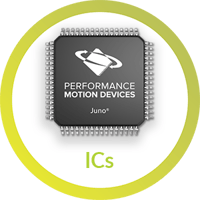
MC73112 Brushless Motor Torque Control IC
The MC73112 and MC73112N single axis control ICs are members of PMD’s Juno family of ICs and are a perfect solution for low cost, high performance BLDC motor control. The MC73112 provides advanced features such as Field Oriented Control, high/low PWM bridge control signals, leg current sensing, and more. Available in packages as small as 7mm x 7mm and costing $12 in quantity, these ICs are an ideal solution for your next machine design project using brushless motors.
Learn more >>
MC73113 Brushless Motor Velocity Control IC
The MC74113 and MC74113N are members of the Juno family of ICs and are perfect for building low cost, high performance stepper motor controllers. Juno ICs feature advanced two-phase waveform generation, high/low switching amplifier control signals, leg current sensing, and more. Available in packages as small as 7mm x 7mm and costing $12 in quantity, these ICs are an ideal solution to upgrade your existing pulse & direction controller for microstepping or closed loop stepper operation, or for starting your next machine design project from scratch.
Learn more >>
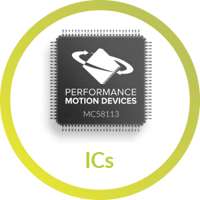
MC53113 Brushless Motor Positioning Control IC
The MC53113 single axis control IC is a member of PMD’s Magellan family of ICs and is a perfect solution for low cost, high performance BLDC motor control. The MC53113 provides advanced features such as s-curve profile generation, PID position loop control with feedforward, two direct encoder channel inputs, Field Oriented Control, direct PWM bridge signals, and more. Available in a 100-pin TQFP package the MC53113 IC is an ideal solution for your next machine design project using brushless motors.
Learn more >>
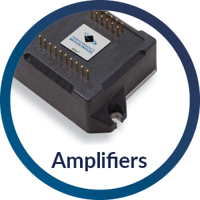
Atlas Brushless Motor Amplifier
Atlas BLDC Motor Amplifiers are compact single-axis amplifiers that provide high-performance FOC current control of three-phase brushless DC motors. Atlas amplifiers are PCB-mountable modules measuring as small as 27 x 27 x 14mm, come in both a vertical and horizontal mounting configuration and are available in three power ranges: 75W, 250W, and 500W.
Learn more >>
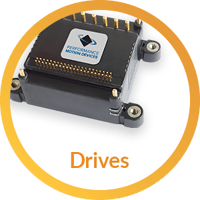
ION/CME N-Series Brushless Motor Drive
N-Series ION Drives are ultra-compact single-axis PCB-mountable brushless motor drives that provide S-curve point to point profiling, quadrature, sin/cos, and BiSS-C encoder input, downloadable user code, general purpose digital and analog I/O, advanced PID position loop control, and much more. They support Ethernet, RS232, RS485, CAN FD, and SPI (Serial Peripheral Interface) communications. N-Series ION Drives measure just 37 x 37 x 17mm and are available in three power ranges: 75W, 350W, and 1,000W.
Learn more >>
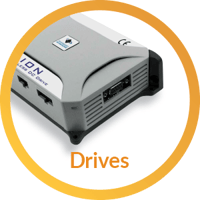
ION 500/3000 Brushless Motor Drive
ION 500 and ION 3000 Series Drives are compact single-axis cable-connected brushless motor drives that provide S-curve point to point profiling, quadrature encoder input, downloadable user code, general purpose digital and analog I/O, advanced PID position loop control, and much more. They support Ethernet, RS232, RS485, and CANbus communications. ION 500 drives provide 500W with 12-56V DC supply input and ION 3000 Drives provide 3,000W with 20-190V DC supply input.
Learn more >>
You may also be interested in:
- PMD Positioning Motion Control ICs Applications Summary (Article)
- OLogic Case Study - Robotics Design Firm (Case Study)
- ION/CME N-Series Drive Applications Summary (Article)
- Build vs. Buy of a Three Axis Motion Controller (Article)