
 QuickBytes
 For further analysis, read: Build vs Buy of a Three Axis Motion Controller For further analysis, read: Build vs Buy of a Three Axis Motion Controller |
Why Motion Architecture Choice Matters
Choosing between a motion control IC and a motion module is not only a hardware decision. It can affect development time, software effort, production cost, tuning workflow, board design complexity, and long-term scalability.
For OEMs building robotics systems, semiconductor equipment, medical devices, laboratory automation platforms, or precision manufacturing machines, the motion architecture selected early in development can influence the full product lifecycle.
A motion module may help a team prototype faster and reduce integration risk. A motion control IC may provide more flexibility, tighter integration, and lower unit cost at higher production volumes. In many projects, the right choice depends on where the product is in the design cycle and how much motion control engineering the team wants to own internally.
Motion control IC vs motion module selection depends on development resources, production volume, integration complexity, software strategy, and long-term cost goals. A module can often reduce early design effort, while a motion control IC may be a better fit for teams that need deeper integration, custom board design, or cost optimization at scale.
What Is a Motion Control IC?
A motion control IC is a chip-level component that provides core motion control functions inside a machine’s embedded electronics.
Depending on the product and application, a motion control IC may support functions such as:
- Trajectory generation
- Position control
- Velocity control
- Torque control
- Commutation
- Multi-axis coordination
- Host communication
- Motion event handling
Motion control ICs are typically used when engineers want to integrate motion control directly into a custom PCB or embedded system.
This approach can be useful when the design requires:
- Compact electronics
- Custom board layout
- Lower production unit cost
- Deeper integration with system electronics
- More control over the final hardware architecture
- A long-term production strategy
A motion control IC generally requires more engineering effort than a module, but it can provide greater design flexibility and cost advantages in the right production environment.
What Is a Motion Module?
A motion module is a more integrated motion control building block that packages motion control functionality into a ready-to-integrate format.
A module may include more of the supporting hardware, interface circuitry, power electronics, firmware, connectors, or development infrastructure needed to get a motion system running.
Motion modules are often used when teams want to:
- Prototype faster
- Reduce hardware design risk
- Simplify integration
- Avoid designing a full motion control board from scratch
- Validate performance earlier in development
- Reduce the amount of specialized motion control hardware work required
A module may not provide the same unit-cost profile as an IC-based design at high production volumes, but it can reduce development time and help teams move faster during early-stage design.
Key Motion Control Terms
Motion Control IC
A chip-level component that provides embedded motion control functionality inside a custom machine design.
Motion Module
A more integrated motion control building block designed to reduce hardware development and integration effort.
Embedded Motion Control
A motion architecture where control functionality is located directly in the machine.
Software Continuity
The ability to reuse or adapt software across different motion control hardware options with limited disruption.
Prototype-to-Production Migration
The process of moving from an early development architecture to a production-optimized motion control design.
Integration Effort
The engineering time and complexity required to design, connect, configure, tune, and validate a motion control system.
Key Insight
A motion module can reduce development effort, while a motion control IC can reduce long-term unit cost. The right choice depends on application requirements, engineering resources, and production goals.
Motion Control IC vs. Motion Module: Key Differences
Motion control ICs and motion modules solve different engineering problems. One is not universally better than the other. The better choice depends on the machine, the team, the production plan, and the desired level of integration.
|
Design Factor |
Motion Control IC |
Motion Module |
|
Integration effort |
Higher |
Lower |
|
Time to prototype |
Longer |
Shorter |
|
Unit cost at scale |
Often lower |
Often higher |
|
PCB design complexity |
Higher |
Lower |
|
Design flexibility |
Higher |
Moderate |
|
Engineering resources required |
Higher |
Lower |
|
Production scalability |
Strong |
Strong, depending on volume |
|
Hardware customization |
High |
Moderate |
|
Development risk |
Higher if team lacks motion expertise |
Lower in many cases |
A module may help a team move faster. An IC may help a team optimize cost, size, and architecture once the design requirements are well understood.
When Should Engineers Consider a Motion Control IC?
A motion control IC is often a good fit when the engineering team wants more control over the embedded motion architecture.
Engineers may consider a motion control IC when:
- Production volume justifies deeper integration
- Lower unit cost is an important long-term goal
- The team has embedded hardware design resources
- A custom PCB is already part of the product plan
- Space constraints require a compact architecture
- The application needs deeper integration with machine electronics
- The design roadmap supports a longer development cycle
- The team wants to optimize the final production architecture
A motion control IC can be especially useful when the motion system is part of a larger embedded design and the team wants to integrate motion control directly into the final product.
Practical guidance
Before selecting a motion control IC, engineers should evaluate:
- Internal motion control expertise
- PCB design resources
- Firmware and software development requirements
- Tuning and diagnostic workflow
- Production volume
- Validation effort
- Long-term cost targets
If the team has the resources to manage these areas, an IC-based approach may provide meaningful long-term advantages.
When Should Engineers Consider a Motion Module?
A motion module is often useful when speed, simplicity, or risk reduction matter more than minimizing unit cost.
Engineers may consider a module when:
- Time to prototype is important
- Motion control expertise is limited
- Hardware design resources are constrained
- The team wants to validate motion performance quickly
- The application is in early-stage development
- Production volume is uncertain
- Reducing integration risk is a priority
- The team wants a more complete motion building block
Modules can be particularly helpful when an OEM needs to prove out the machine concept, validate motion requirements, or accelerate development before committing to a more customized architecture.
Practical guidance
Before selecting a module, engineers should evaluate:
- Prototype timeline
- Integration complexity
- Available engineering resources
- Expected production volume
- Space and packaging requirements
- Cost targets
- Future migration plans
A module can be a practical choice when getting a machine working quickly is more important than optimizing every element of the final production design.
How Module-to-IC Migration Can Support Long-Term Cost Reduction
In many product development cycles, the best architecture for the prototype is not always the best architecture for production.
A module may be appropriate early because it helps engineers reduce development effort and validate the application. Later, once the design is stable and production volume increases, an IC-based architecture may become attractive because it can reduce unit cost and provide more control over the final hardware design.
This creates a potential migration path:
- Use a module to accelerate early development.
- Validate the machine architecture and motion requirements.
- Develop and test application software.
- Evaluate whether production volume justifies deeper integration.
- Migrate toward an IC-based design where cost, size, or scalability benefits justify the effort.
This approach can be valuable when planned early. Software continuity, development tools, documentation, and architecture compatibility all influence how much effort is required to move from one hardware approach to another.
Why software continuity matters
Changing hardware platforms can create risk if the software architecture changes significantly.
When software can be reused or adapted across related motion control platforms, teams may reduce:
- Rework
- Validation effort
- Debugging time
- Development risk
- Migration complexity
Software continuity does not eliminate all migration effort, but it can make architecture changes more manageable when teams plan for scalability from the start.
How to Choose Between a Motion Control IC and a Motion Module
The best choice depends on the project’s technical and business constraints.
Engineers should consider the following decision factors.
1. Development Timeline
If the team needs a working prototype quickly, a module may be the better starting point.
If the project has a longer design window and a clear production roadmap, an IC-based design may be worth evaluating earlier.
2. Engineering Resources
A motion control IC generally requires more hardware and software integration work.
A module can reduce the amount of custom design required, which may be helpful for teams with limited motion control experience or constrained engineering bandwidth.
3. Production Volume
At lower volumes, the reduced development effort of a module may outweigh unit cost differences.
At higher volumes, the cost advantages of an IC-based architecture may become more meaningful.
4. Board Space and Mechanical Constraints
If the final product has strict space constraints, an IC-based design may allow tighter integration.
If packaging flexibility is available, a module may simplify development.
5. Customization Requirements
If the system requires a highly customized electrical or mechanical architecture, a motion control IC may provide more flexibility.
If standard integration is acceptable, a module may reduce design effort.
6. Long-Term Cost Goals
Cost should include more than component price.
Engineers should evaluate:
- Hardware cost
- Software development effort
- Debugging time
- Commissioning time
- Validation effort
- Support requirements
- Redesign risk
- Production volume
A lower component cost does not always mean a lower total engineering cost. The best architecture is often the one that balances cost, performance, schedule, and development risk.
What Should Engineers Look for When Evaluating Motion Control Platforms?
As motion systems become more sophisticated, engineers evaluating motion control platforms should consider not only motion performance specifications, but also the tools available for configuration, diagnostics, tuning, and long-term system optimization.
When comparing a motion control IC vs motion module, engineers should look for:
- Software portability across product families
- Development tools for configuration and tuning
- Motion diagnostics such as Motion Trace
- Support for position, velocity, and torque control
- BLDC and step motor support, if required
- Multi-axis control capability
- Clear documentation and programming references
- Prototype-to-production architecture options
- Support for motion control ICs, drives, amplifiers, and machine controllers
- A migration path that supports future cost or performance optimization
Product evaluation questions
Engineers should ask:
- Does this architecture support the required motion performance?
- How much hardware design effort is required?
- How much software development effort is required?
- Can the same software approach support future hardware changes?
- Are tuning and diagnostic tools available?
- Can the architecture scale from prototype to production?
- Does the platform support the motor types and axis counts required?
- What level of support is available during development and commissioning?
These questions help move evaluation beyond “Which part meets the spec?” toward “Which platform best supports the full machine development process?”
The PMD Difference
PMD supports multiple levels of motion control integration, allowing engineers to select an architecture that fits the design stage rather than forcing every project into the same product category.
Depending on the application, teams can evaluate PMD Positioning ICs, PMD Velocity Control ICs, PMD Torque Control ICs, PMD Drives, PMD Amplifiers, and PMD motion boards based on whether they need:
- Faster development
- Deeper integration
- Lower production cost
- More control over the final electronics
- Integrated tuning and diagnostic tools
- A scalable migration path
- Support for BLDC, step motor, or multi-axis motion systems
PMD also provides software and development tools such as C-Motion® and Pro-Motion® Software, which can help engineers configure, tune, diagnose, and optimize motion systems through a consistent workflow.
For OEMs, this matters because architecture decisions often change over time. A team may need a higher-integration option during early development and a more cost-optimized IC-based approach for production. PMD’s range of motion control options can help engineering teams evaluate those tradeoffs while maintaining focus on performance, software strategy, and long-term scalability.
The PMD difference is not simply that multiple product types exist. It is that engineers can evaluate motion control architecture as a lifecycle decision—from prototype through production—while using tools and support designed for precision motion development.
Motion IC vs. Motion Module in Real-World Applications
Robotics
A robotics team may use a module to validate axis performance, payload behavior, and motion profiles early in development. As production volume increases, the team may evaluate an IC-based design to reduce cost, customize the electronics, or improve packaging.
Semiconductor Equipment
Semiconductor systems often require precise control, deterministic timing, and strong diagnostic visibility. Engineers may evaluate ICs, modules, drives, or machine controllers depending on axis count, synchronization needs, packaging limits, and long-term maintainability.
Medical Devices
Medical device teams often balance development risk, regulatory timelines, packaging constraints, and production cost. A module may help reduce early development complexity, while an IC-based design may support compact and cost-optimized production hardware.
Laboratory Automation
Laboratory automation platforms frequently require reliable, repeatable motion across many axes or stations. Modules can help teams prototype faster, while ICs may support long-term scalability and more customized control electronics.
Industrial Automation
Industrial automation designers may compare integration complexity, serviceability, production volume, and performance requirements. The right architecture often depends on whether the system is a low-volume specialized machine or a scalable product platform.
Key Takeaways
- Motion control ICs and motion modules solve different engineering problems.
- Modules can reduce integration effort and help shorten prototype development.
- ICs can support deeper integration, custom form factors, and lower unit cost at scale.
- The best option depends on engineering resources, production volume, software strategy, and performance requirements.
- Software continuity can reduce migration effort when moving from one architecture to another.
- Engineers should evaluate tools, diagnostics, documentation, and long-term support—not only motion specifications.
- PMD supports multiple motion control architecture options, helping teams evaluate fit from prototype through production.
Frequently Asked Questions
What is the difference between a motion control IC and a motion module?
A motion control IC provides motion control functionality at the chip level, while a motion module provides a more integrated building block that can reduce hardware design and integration effort.
When should engineers use a motion control IC?
A motion control IC is often appropriate when a team needs custom board integration, lower unit cost at production volume, or more control over the embedded motion architecture.
When should engineers use a motion module?
A motion module is often useful when faster development, lower integration effort, or reduced hardware design risk is more important than minimizing unit cost.
Can teams migrate from a module to an IC?
In some cases, teams can use a module during early development and later evaluate an IC-based design for production cost optimization. Software compatibility and architecture planning are important factors.
How should engineers choose between ICs, modules, drives, and machine controllers?
Engineers should evaluate motion performance, integration complexity, development resources, production volume, software tools, diagnostics, and long-term scalability.
Why does software continuity matter in motion control architecture?
Software continuity can reduce redesign effort, simplify validation, and make it easier to move from prototype to production when changing hardware architecture.
Compare PMD Motion Control Options for Your Application
Choosing between a motion control IC and a motion module depends on performance requirements, development resources, production volume, software strategy, and long-term cost goals.
Explore PMD motion control platforms to compare architecture options and evaluate which solution best fits your machine design.
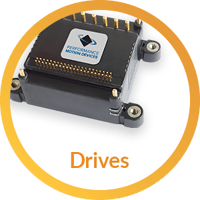
ION/CME N-Series Drives
ION®/CME N-Series Drives are high performance intelligent drives in an ultra-compact PCB-mountable package. In addition to advanced servo and stepper motor control, N-Series IONs provide s-curve point to point profiling, field oriented control, downloadable user code, general purpose digital and analog I/O, and much more. These all-in-one devices make building your next machine controller a snap.
Learn more >>
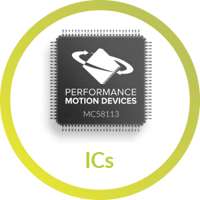
MC58113 Series ICs
The MC58113 series of ICs are part of PMD's popular Magellan Motion Control IC Family and provide advanced position control for stepper, Brushless DC, and DC Brush motors alike. Standard features include FOC (Field Oriented Control), trapezoidal & s-curve profiling, direct encoder and pulse & direction input, and much more. The MC58113 family of ICs are an ideal solution for your next machine design project.
Learn more >>
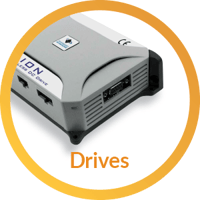
ION 500 & 3000 Drives
ION 500 and 3000 Drives are high performance intelligent drives in a compact cable-connected package. In addition to advanced servo motor control, IONs provide s-curve point to point moves, i2T power management, downloadable user code, and a range of safety functions including over current, over voltage, and over temperature detect. IONs are easy to use plug and play devices that will get your application up and running in a snap.
Learn more >>
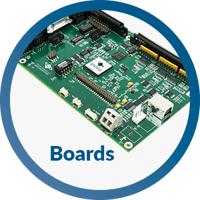
Prodigy/CME Machine Controller
Prodigy®/CME Machine Controller boards provide high-performance motion control for medical, scientific, automation, industrial, and robotic applications. Available in 1, 2, 3, and 4-axis configurations, these boards support DC Brush, Brushless DC, and stepper motors and allow user-written C-language code to be downloaded and run directly on the board. The Prodigy/CME Machine-Controller has on-board Atlas amplifiers that eliminate the need for external amplifiers.
Learn more >>
You may also be interested in:
- PMD Positioning Motion Control ICs Applications Summary (Article)
- OLogic Case Study - Robotics Design Firm (Case Study)
- ION/CME N-Series Drive Applications Summary (Article)
- Build vs. Buy of a Three Axis Motion Controller (Article)